

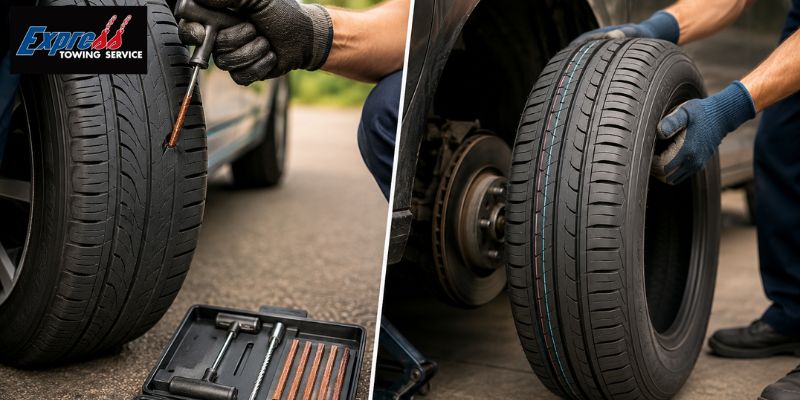
You’re running late for work and sipping on your cup of coffee when you realize—it’s flat! Everyone has experienced disappointment. However, the issue that will make the repair take either 20 minutes or $200: Can I repair this tire, or do I have to replace it? Every year, about 94 million flat tires are reported in the United States—three every second. This is a dilemma faced by millions of drivers every single year—and making the wrong choice can cost you time, money, and even your safety! Flat tire repair vs replacement guide is here.
All flat tires are not alike. It is the combination of just three things that make it either a quick fix or something that needs professional attention: location, size, and type of damage.
Imagine that the tire is like a clock face. The tread—the big chunk of rubber on the outside of the tire—is located between 10 o’clock and 2 o’clock on top. Think about your tire as if it were a clock face. The tread, the thick rubber area which makes contact with the road, runs across the top of the clock face, approximately from 10 o’clock to 2 o’clock. This area is where repairs can be safely made.
Repairs made on the sidewall, which is the vertical part of the tire that attaches to the rim and that flexes continuously while driving, are subject to stress and can fail, sometimes resulting in a blowout while driving at highway speeds. Although it’s unfortunate, 80% of punctured tires receive their punctures through the sidewall, which is why so many flat tires cannot be repaired.
For example, last month, a co-worker drove over a landscaping stake that punctured the sidewall of her tire, which is designed for all seasons. The tire repair shop would not even attempt to repair this tire because when your sidewall is damaged, it automatically requires that it be replaced. No exceptions.
Most tire professionals limit the size of holes that can be repaired to ¼ inch (6mm) in diameter. Any hole larger than that will compromise the structural integrity of the tire. A standard nail or screw can usually be repaired, but a jagged piece of metal that has torn a hole through the tire will typically require the tire to be replaced.
Sharp road debris is responsible for 64% of tire punctures. That nail you found on the road after driving through a construction area is the best-case scenario. Small, clean punctures in the tread of tires are the most common candidates for repair.
The average price of flat tire repair across the country is approximately $22, compared to $100 – $300 for a new tire, depending on the size and brand. That’s a huge price difference for what could be a 30-minute repair.
There are times when you have to replace your tire to make it safe again. If you know what these are, you can avoid the hassle of taking a tire to the shop and learning it’s not repairable. Repair vs replace flat tire is not always the concern. You need to understand the negotiability.
If there is a puncture, cut, bulge, or bubble in the sidewall of the tire, the tire cannot be repaired. This is because it’s not overly cautious; it is due to physics. Sidewalls handle tremendous amounts of stress when cornering and braking. When the sidewall has weakened, it creates a ticking time bomb for catastrophic failure.
Approximately 15% of all new cars come with run-flat tires, which allow one to travel about 50 miles at 50 mph when a puncture occurs. But here is something most people aren’t aware of: driving further than these limits or above the maximum speed will result in irreparable damage to the tires’ structure. One cannot use a run-flat tire driven 80 miles without air pressure anymore, even if it appears to be undamaged.
At least 2/32-inch of tread is required by law for safety in the United States. In case of a puncture of a tire, which is already close to reaching this minimum, repairing isn’t worth it because replacement is imminent anyway. According to the NHTSA, a vehicle with low tread tires has three times higher chances of being part of an accident.
Even if the tire appears perfect, the rubber deteriorates with time. The general recommendation from the industry is to change tires that are older than 10 years. It means that in some cases, a puncture is a sign that the tires have become too old.
And here’s an issue that most people didn’t anticipate—over 30% of new vehicles currently on the market don’t come equipped with spare tires.
The reason for this is that manufacturers have ditched them in order to save on weight and reduce costs. What once was a 30-minute tire change is now, for many drivers, a process lasting up to four hours, consisting of towing, waiting for repair, and buying a new tire at once. Only around 10% of new vehicles come equipped with a full-sized spare, while approximately 60% have a “donut” spare, and the rest have sealant kits, run-flats, or nothing at all.
Before your car leaves you high and dry, make sure you know what it has in its trunk—and if you have a sealant kit, know its limits because it works only for small tread punctures.
Now that you’ve found yourself with a flat tire on the side of the road, you should answer these questions:
Sidewall? Replace the tire. Tread? It could possibly be repaired.
If the hole is larger than the size of a pencil eraser, then the tire needs to be replaced.
If the tread is about 2/32 inch deep, it will need to be replaced when the tire is changed.
Tires should be replaced once they are older than six years.
If so, you will have to see how far you drove it. If the distance is beyond the limit for your tire, you will need to replace it.
According to a 2024 Hankook survey, 41% of drivers have been affected by either a flat tire or a blown-out tire in the last 12 months. Of those affected by a flat, only 74% of them know how to change their tire, and only 57% changed their tire themselves; 22% called for roadside assistance to have a tire changed.
When making the calculation of the “real” price of repair vs replacement, the time waiting for roadside assistance needs to be included. AAA has reported that the average wait time for roadside assistance is more than an hour. Tow fees (if a driver is not covered by roadside assistance), and the potential tire safety concerns of a defective tire failing at high speeds also need to be factored into the cost vs. benefit decision. In 2020, NHTSA reported that there were 664 fatal tire-related crashes. A $22 repair on a tire that is marginally safe is not actually a deal if the same tire fails on the Interstate in 3 months!
You have to be concerned about tire safety. Ultimately, the choice between repair and replacement comes down to one simple idea: the tires are what keep your 3,000-pound vehicle on the ground. If in any doubt, replacement is better. The additional cost of $150 is easily worth it for that added piece of mind when you hit the highway. So now you know about how to repair vs replace a flat tire. Express Towing Services can tow your car or offer you the best tires to relieve you.
No, a flat tire cannot always be repaired unless the problem occurs in the tread section and the hole is less than ¼ inch (6 mm) in size. Punctures in the sidewalls or big holes usually result in a necessity of replacing the tire.
Usually, the price of flat tire repair varies between $15 and $40, and is relatively low compared with the replacement of the tire, which costs $100-$300 and more.
If the tire has a hole in the sidewall, its diameter is greater than ¼ inch, there is not enough tread left or the tire has structural damage, it should be replaced.
Yes, if the tire has been repaired properly by a professional and it has met the required repair standards set by the industry. The repair of the tread area of a tire is normally good for the life of the tire.
No, it cannot. Sidewall punctures, cuts, bulges, or bubbles cannot be repaired due to the constant flexing of the sidewall when driving.


