

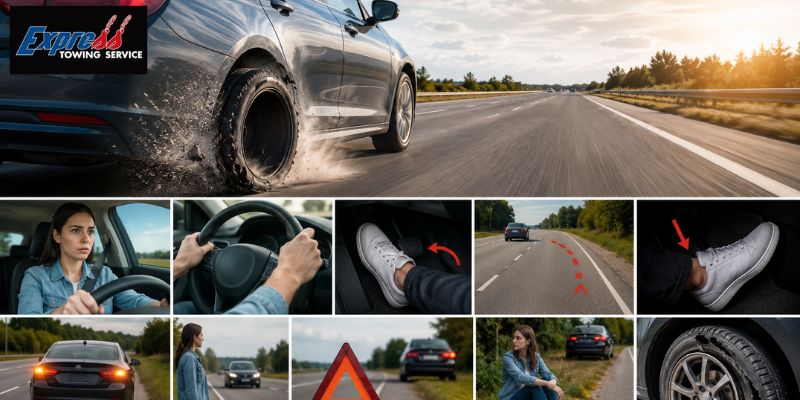
A tire blowout is among the most terrifying experiences for any driver. You are driving one minute, and suddenly there’s a bang, your steering wheel jerks, and you realize your car is no longer responsive to your commands. It is in these few seconds that your response to the situation will determine whether you are going to have a safe ending or a crash. What to do during a tire blowout should be known by all.
Tire blowouts are responsible for thousands of traffic accidents annually, according to the statistics provided by the National Highway Traffic Safety Administration (NHTSA). Even though today’s tires are highly durable compared to their earlier versions, factors like underinflation, overload, road hazards, temperature, and improper maintenance lead to a blowout of the tires.
Luckily, by being prepared for a tire blowout, you are likely to be in a safer position when it happens. By following this guide on how to react during a tire blowout, prevent it and get help from roadside assistance, you are likely to survive safely. Unlike a slow leak or a standard flat tire, a blowout happens suddenly and often at highway speeds.
Common causes include:
On a road trip during the summer, a family faced a situation where their back tire went flat at around 70 mph. They were quite scared in the beginning and applied the brakes abruptly. Thankfully, owing to their driving experience for many years, they regained their calm, released the brakes, and steered the car safely out of danger.
Everyone is well aware of the fact that the initial moments are very important.
Blowout doesn’t necessarily begin with an explosion.
Some of these symptoms are:
The initial instinct might be one of panic. But being coolheaded is the first step you should take. A number of accidents happen not because of a blowout but due to a driver’s overreaction. Make sure you retain control over the car.
Once a tire blows out, there is a high possibility that the vehicle will jerk to one side. Grip the steering wheel tight with both your hands. Try not to make any abrupt movements in the direction of the steering wheel.
Apply heavy brakes at once. Sudden application of brakes in case of a blowout may cause:
Let the car slow down on its own.
Ease off the accelerator slowly. This helps the car slow down in a safe manner without disturbing the balance. Modern cars are made in such a way that they will be stable if the driver does not make any harsh moves.
When the speed reduces, it becomes easier to control the steering. Wait until the car slows down to apply brakes carefully, if necessary.
After taking control of the car:
Choose an area away from moving cars wherever possible.
After stopping, the next steps are:
Hazard lights signal to other motorists that your car is broken down. Visibility becomes crucial in the dark and bad weather conditions.
Provided it’s possible, remove yourself and any passengers out of the way of moving vehicles. Most cases of injury result after the initial problem of breaking down.
Check the following:
However, try not to stand beside moving lanes while inspecting the car.
That depends on the circumstances.
Performing a tire change would be appropriate if:
But many instances at the roadside just aren’t conducive to performing repairs yourself.
A driver was stuck in rush-hour traffic on a small shoulder due to a tire blowout, even though they had a spare tire. Performing the change in that scenario could have been risky. Instead, they called roadside assistance, which performed the repair safely. Learning when not to change your own tire can be just as valuable as learning how to change it.
Roadside assistance from a professional will usually be your best choice.
Some considerations include:
This could potentially:
Your emergency kit must have at least the following:
Often preparation helps to make your experience easier when stuck by the road.
Some drivers only discover after the fact that:
Regularly check your spare tire.
Not all blowouts can be avoided, but the majority of them can.
Studies done by the tire industry show that underinflated tires are one of the largest contributors to tire failure.
When your tires are properly inflated, your:
When your tires’ tread is worn down, you will not have as good of traction, and your tires are more likely to be damaged. You should replace your tires before the tread has started to wear excessively.
Every vehicle has an absolute maximum amount of weight that can be put on it. Putting too much weight on your tires causes excessive stress on your tires.
By rotating tires every six (6) months, you will receive a more even wear pattern and will be able to get more life out of your tires.
Tires age, and if your tires are older but have plenty of tread, then you still may need to replace them. Manufacturers generally recommend a visual inspection be completed, or the tires be replaced after four (4) to five (5) years.
Experiencing a tire blowout can be frightening, but understanding what to do during a tire blowout significantly improves your chances of staying safe. The key principles are simple:
Whether you’re dealing with a flat tire, requiring a tire change, or calling for roadside tire help, preparation and knowledge are your best defenses. Express Towing Services can be a good choice if you are looking for a tire service.
By following proper emergency tire safety practices and maintaining your tires regularly, you can reduce the likelihood of a blowout and travel with greater confidence wherever the road takes you.
Stay calm and maintain a firm grip on the steering wheel. Avoid slamming on the brakes and gradually ease off the accelerator while keeping the vehicle moving straight.
Yes. A flat tire usually loses air gradually, while a blowout involves a sudden and rapid loss of tire pressure that can affect vehicle control.
No. Sudden braking can make the vehicle unstable. Allow the vehicle to slow naturally before applying gentle braking if necessary.
You should seek roadside assistance if traffic conditions are unsafe, you don’t have a spare tire, the wheel is damaged, or you’re unable to safely perform a tire change yourself.
Many blowouts can be prevented through routine tire inspections, proper inflation, tread monitoring, tire rotations, and replacing aging or damaged tires before they fail.


