

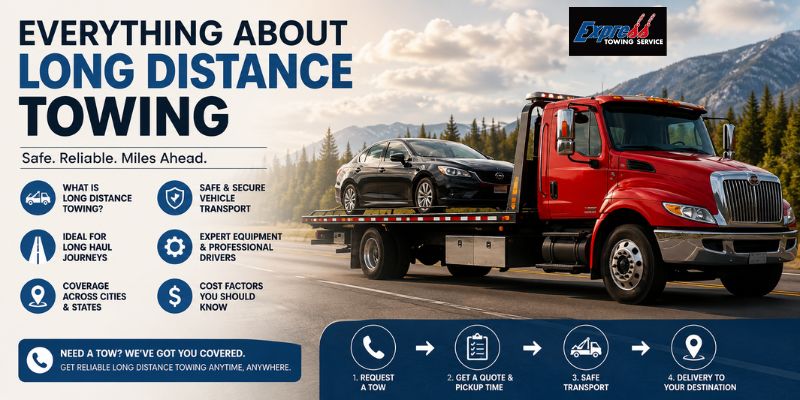
A vehicle breakdown is stressful. It becomes even more challenging when the destination is many kilometers away. Your car might have mechanical damage or have been involved in an accident. So, understanding the long distance towing cost in Canada can help you prepare both financially and practically.
Many people assume towing companies charge a flat rate. That is rarely the case. Every towing job is different. The final cost depends on several variables. These include the type of vehicle, the towing distance, road conditions, equipment requirements, and the urgency of the service.
Understanding these towing cost factors allows vehicle owners to make informed decisions and avoid unexpected charges. The towing cost-impact factors should be discussed in detail so that you get a clear understanding of the towing costs.
Local towing usually involves transporting a vehicle a short distance to a nearby repair shop. Long-distance towing requires more planning. It also demands more time, fuel, specialized equipment, and labour.
A towing operator may spend several hours on the road for a single job. During that time, the tow truck is unavailable for other customers. Fuel expenses increase. Driver hours increase. Vehicle wear also increases. These operational costs contribute to higher pricing for long-distance towing services.
The rate for long-distance towing services will differ throughout Canada depending on varying distances, costs of fuel, provincial laws, and availability of the services.
Most towing companies quote their rates based on two elements. The first element is the base service rate. The second element is the rate charged per kilometer after the first few kilometers. Some additional charges could apply where specialized recovery equipment or late hours are needed.
For instance, towing a car to a nearby city can be relatively cheaper compared to long-distance towing. Even long-distance towing on highways is usually cheaper compared to vehicle recovery from remote rural areas. Getting a quotation prior to making the arrangement makes the whole process easier.
There are multiple towing cost factors that can influence costs.
The longer the journey, the higher the overall towing cost. A tow covering 50 kilometres requires far fewer resources than transporting a vehicle 500 kilometres or more.Long-distance trips involve additional fuel consumption, longer driver shifts, increased truck maintenance, and greater scheduling commitments.
Many companies offer competitive pricing for extended journeys. This is because the per-kilometre rate may decrease as distance increases. However, the total cost generally remains higher because of the longer travel time.
Vehicle weight directly affects towing costs. A compact sedan is much easier to transport than a large pickup truck, commercial van, or recreational vehicle.
Heavier vehicles require stronger towing equipment. They also consume more fuel during transport. Specialized heavy vehicle towing pricing reflects the additional equipment and expertise needed to safely transport larger vehicles. For example, moving a delivery truck requires a different tow truck than transporting a small passenger car.
Not every vehicle can be towed using a tow truck. Some vehicles have locked wheels. Some vehicles may suffer from collision damage or suspension failures. In such cases, additional recovery processes are required before the transportation begins. Professional recovery may include winches, dollies, airbags, or special lifting systems. The more complicated the recovery process, the higher the total price of towing may become.
Urban towing is usually less complicated than rural recovery services. The major Canadian cities normally feature many towing service companies working nearby. Remote highways, northern areas, mountain roads, or isolated construction sites are harder to access. Long-distance traveling of the tow truck only to reach the disabled vehicle means extra expenses even before the towing process itself starts.
Emergency towing services provided during non-working hours may be charged additionally. Late-night breakdowns, weekend periods, statutory holidays and harsh winter conditions may affect the pricing process.
For instance, a vehicle breakdown during snowstorms involves additional measures and lower travel speeds. Such conditions add extra expenses to the towing service provider but also ensure the safety of drivers and clients.
The type of car determines the type of towing equipment needed. For example, a typical wheel-lift tow truck might work perfectly fine for local towing. For long-distance towing, one might want to consider using a flatbed truck that keeps all four wheels off the ground.
Using flatbed towing is a much safer method for transporting expensive vehicles, electric vehicles, vintage cars, and all-wheel-drive automobiles. Although the flatbed method might cost extra, it eliminates the danger of extra wear while transporting the vehicle over long distances.
There are cases where towing involves more than just transporting the car. For instance, the technician will have to jump-start a car with a dead battery before loading it onto the flatbed. A technician may need to boost a dead battery before loading the vehicle. The vehicle may need to be winched from a ditch. Tire changes, fuel delivery, or lockout assistance may also be required before towing can begin. These additional services contribute to the overall towing cost but often eliminate the need for multiple service providers.
Towing could be a better and cheaper option sometimes. Driving a car with issues might increase the existing problem. Driving on an overheated engine, faulty transmission, or failing suspension system might cost you much more money than professional towing would.
For instance, a family going on vacation across Canada realizes that there are issues with the transmission system after traveling a few hundred kilometers. To avoid total damage, they hire a professional long-distance towing service. Although it will cost some money, in the end it will save them a lot. Professional towing is beneficial not only for the vehicle but for the people as well.
Cost shouldn’t be the main factor in towing cost of vehicle transport. A professional towing company has a clear pricing policy, up-to-date equipment, and properly trained operators with correct insurance coverage. You should choose companies that provide you with detailed information about the cost before starting the process. Professional operators also inspect the vehicle before loading it to ensure it is transported safely throughout the journey. Choosing an experienced provider helps reduce the risk of delays or damage during
Towing services go beyond just transporting your car from point A to B. Towing experts have knowledge of weight distribution, loading processes, provincial transport laws, and road safety practices.
They also have special equipment that is used for safely transporting vehicles over thousands of kilometres. Regardless of whether your vehicle is a passenger car, SUV, truck, motorcycle, or professional towing provides peace of mind throughout the journey.
There are different factors that affect the towing charge for long distance towing in Canada. The majority of car owners are interested in heavy vehicle towing pricing. The different aspects include distance, vehicle size, location, requirements, towing equipment, and time. Learning about the factors affecting the towing charges can assist the vehicle owner to plan ahead and reducing any costs.
Though long distance towing cost in Canada can be high, the towing process can be considered cheap because it protects the vehicle against other problems. It provides the towing company with the opportunity to provide a quality service that guarantees safe and efficient towing. When the vehicle cannot travel, one should use towing services. Express Towing Services can be booked if your car needs towing.
Long-distance towing rates in Canada are determined by base fees and rate per kilometer. However, the ultimate cost will vary depending on the towing distance, type of vehicle, the level of recovery and the kind of extra services needed.
Some of the major factors that determine long-distance towing cost include the towing distance, type of vehicle, location, condition of roads, special equipment and timing of the towing.
Yes, flatbed towing charges are always higher since they are much safer and preferred for luxury, electric, classic cars and all-wheel drive vehicles.
Yes, heavy towing charges are high due to specialized tow trucks required for such kind of vehicles.
Yes, most towing companies offer advance booking of long distance towing.


