

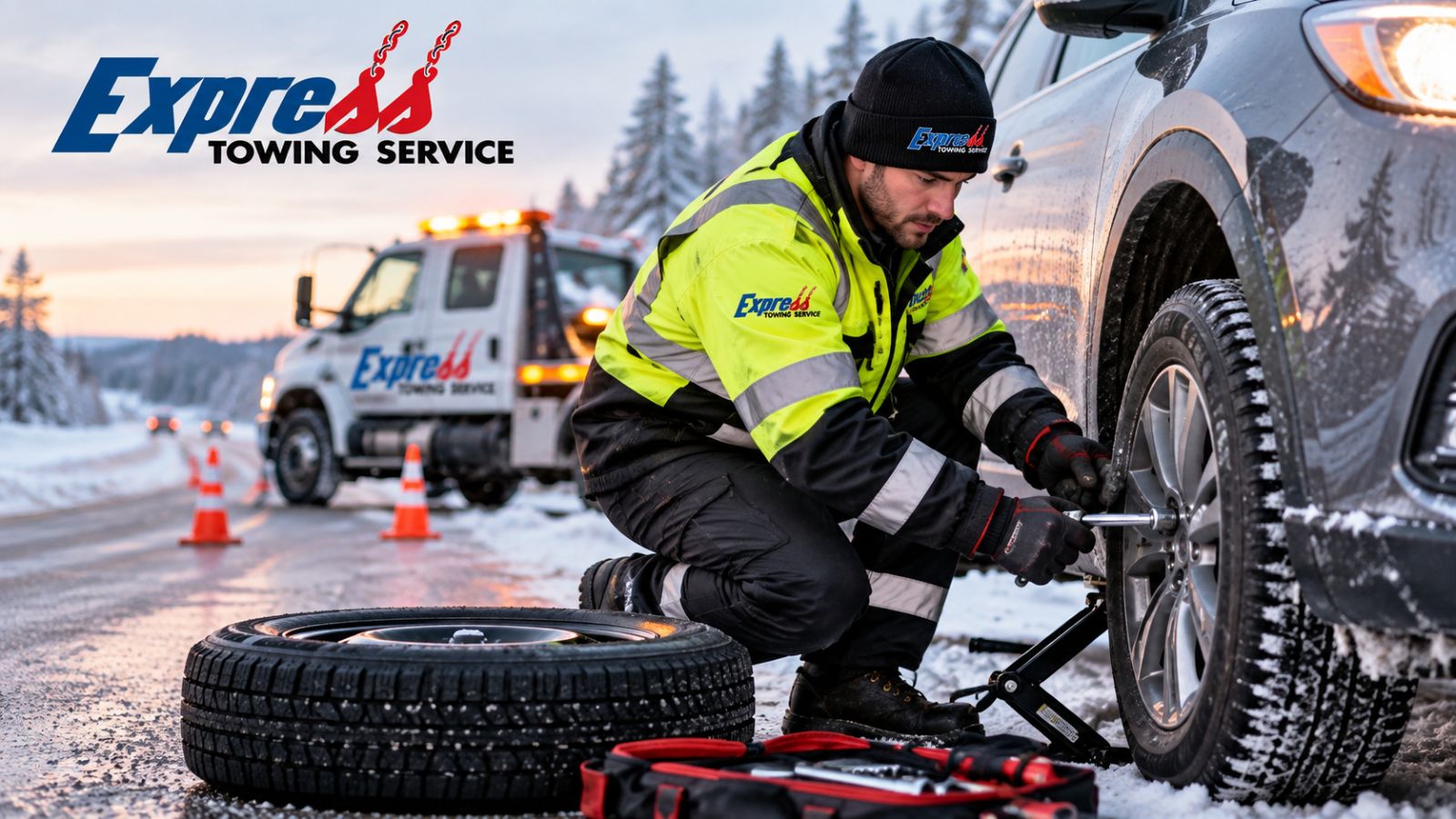
A flat tire can happen when you least expect it. You may be driving to work, heading home after a long day, travelling on a rural highway, or dealing with freezing weather when suddenly the steering feels different and the tire-pressure warning light appears.
Knowing what to do next can make a stressful roadside situation much easier to manage.
For many Canadian drivers, the safest option is to contact a professional flat tire replacement service Canada provider rather than attempting a roadside repair without the right tools, experience, or safe location. A damaged tire may sometimes be repairable, but in other cases, replacing it is the only sensible option.
This guide explains how to respond to a flat tire, when repair may be possible, when replacement is necessary, what roadside assistance typically involves, and how Canadian weather and road conditions can affect tire problems.
A flat tire is more than an inconvenience. Where you stop, the weather, traffic conditions, road surface, and location can all affect how safely the problem can be handled.
Canadian driving conditions create some additional challenges.
Winter temperatures can cause tire pressure to fall. Snow, ice, potholes, road debris, construction zones, and rough shoulders can also increase the chances of tire damage.
A driver who experiences a flat on a busy highway faces a very different situation from someone who gets a puncture while parked in a residential driveway.
This is why professional roadside assistance can be valuable.
A trained roadside technician can assess the situation, determine whether the tire can be safely repaired or replaced, and help the vehicle reach a safer location when necessary.
Your first priority should be safety, not changing the tire as quickly as possible.
If you notice a flat while driving:
If you are on a highway and there is no safe shoulder, do not put yourself in unnecessary danger by standing beside the vehicle trying to diagnose the tire.
In some situations, waiting for professional assistance is much safer than attempting a roadside repair.
One of the most common questions drivers ask is whether a flat tire needs to be replaced or can simply be repaired.
The answer depends on the location and severity of the damage.
A small puncture in the central tread area may sometimes be repairable. A puncture in the sidewall is generally a different matter because the sidewall flexes significantly while the vehicle is moving.
A professional inspection should consider:
Simply seeing air escaping from a tire does not tell you whether the tire is safe to repair.
A tire that has lost most or all of its air can suffer internal damage if driven on.
Even if the original problem was a small nail puncture, continuing to drive may damage the internal structure of the tire.
That can turn a relatively straightforward puncture into a replacement situation.
This is one reason experienced roadside technicians inspect the tire rather than assuming the visible puncture tells the entire story.
Replacement may be appropriate when the tire has suffered serious or unsafe damage.
Common examples include:
Cuts, bulges, tears, or significant punctures on the sidewall can compromise the structural integrity of the tire.
A tire with serious sidewall damage should not simply be plugged and returned to service.
Large punctures or damage extending beyond an area that can safely be repaired may require replacement.
Driving on a severely underinflated or completely flat tire can cause damage that is not obvious from the outside.
Sometimes a flat tire occurs when the tire is already near the end of its useful service life. In that situation, replacing it may make more practical sense than repairing an isolated puncture.
A pothole or impact can damage both the tire and wheel. If the wheel is bent or cracked, replacing the tire alone may not solve the problem.
Not every puncture means you need a new tire.
A qualified technician may determine that a tire is repairable when the damage is relatively small, located in an appropriate tread area, and the tire has not suffered additional internal damage.
Professional assessment matters because a quick visual inspection does not always reveal internal problems.
For example, imagine a driver finds a screw in the middle of the tire tread after returning to their car. The tire has gradually lost pressure, but the driver has not driven on it for an extended distance.
After inspection, the puncture may be suitable for repair.
Now consider a different situation: the same driver notices the tire is flat after travelling several kilometres on it. The visible puncture may be small, but the tire could have suffered internal damage.
The two situations look similar at first but can require completely different solutions.
Professional flat tire repair and roadside assistance Canada services can be useful when you cannot safely or practically deal with the problem yourself.
Depending on the provider and circumstances, roadside assistance may involve:
The exact service depends on the provider, vehicle, tire, location, and type of damage.
It is worth explaining your situation clearly when requesting assistance.
Tell the provider:
This information can help the roadside team arrive better prepared.
A flat tire in a parking lot is inconvenient.
A flat tire on a busy highway is a safety concern.
A flat tire on a remote Canadian road during winter can become a much more serious problem.
For flat tire roadside repair Canada, technicians need to consider not only the tire but also the roadside environment.
If traffic is moving quickly, the shoulder is narrow, visibility is poor, or weather conditions are severe, attempting an extended repair beside the road may not be appropriate.
In such cases, towing the vehicle to a safer location may be the better solution.
Drivers travelling outside major urban centres should also consider service availability before starting a long journey.
Mobile coverage may be limited in some locations. Travel distances can be significant, and roadside providers may need additional time to reach remote areas.
Keeping your vehicle properly maintained and knowing how to contact roadside assistance before an emergency occurs can make a major difference.
Weather does not directly create every flat tire, but seasonal conditions can contribute to tire-related problems.
Tire pressure generally decreases as temperatures fall.
That means a tire properly inflated during a warmer period may show lower pressure when temperatures drop significantly.
Low pressure can affect handling, fuel economy, and tire wear.
Drivers should check tire pressure regularly and follow the vehicle manufacturer’s recommended pressure rather than relying only on how the tire looks.
Freeze-thaw cycles can contribute to potholes.
A hard impact may damage a tire, bend a wheel, or create a slow leak that becomes noticeable later.
After hitting a significant pothole, pay attention to:
If something feels different after an impact, having the vehicle inspected can prevent a small problem from becoming a roadside emergency.
The supplied topic cluster includes flat tire repair and wheel alignment, and the two can sometimes be connected after a significant road impact.
A flat tire itself does not automatically mean the vehicle needs an alignment.
However, if the tire became damaged after hitting a pothole, curb, or other obstacle, the impact may have affected suspension or steering components.
Signs that an alignment inspection may be worthwhile include:
Replacing a damaged tire without addressing an underlying wheel or suspension problem can lead to uneven wear on the replacement tire.
That is why a broader vehicle inspection can be useful after a significant impact.
This is one of the biggest mistakes.
Driving on a flat or severely underinflated tire can cause additional damage and may make the vehicle harder to control.
A driver may focus so heavily on changing the tire that they overlook traffic.
If your location is dangerous, prioritize getting yourself and your passengers to a safer position.
A visible puncture does not automatically mean a tire is repairable.
Damage location and internal condition matter.
Some slow leaks develop over several days or weeks.
Checking tire pressure regularly can help identify a problem before the tire becomes completely flat.
Not every spare tire is designed for normal long-distance driving.
Temporary spare tires often have specific speed and distance limitations. Always follow the vehicle manufacturer’s instructions.
Keeping a few basic items in your vehicle can make a tire emergency easier to manage.
Consider carrying:
You should also know where your spare tire and vehicle tools are located before you need them.
Some modern vehicles do not come with a traditional spare tire, so check your vehicle’s equipment rather than assuming one is available.
Before accepting a roadside tire service, ask clear questions.
For example:
Can you replace the tire at my location?
Some providers offer mobile tire replacement, while others may tow the vehicle to a workshop.
Can you inspect the tire before replacing it?
This helps determine whether replacement is actually necessary.
Do I need to provide the replacement tire?
Some roadside services can supply a suitable tire, while others may require the customer to arrange one.
Is towing available if the tire cannot be repaired?
This is particularly important if the vehicle is stranded in an unsafe or remote location.
Clear communication helps avoid surprises.
There are situations where calling a professional is simply the more practical option.
Professional assistance is especially useful when:
A roadside professional can assess the situation without requiring you to spend unnecessary time working beside traffic.
The phrase 24/7 Emergency Electrician is sometimes used as a blog keyword, but it belongs to a completely different service category.
A driver searching for a flat tire replacement service is looking for roadside assistance, tire repair, mobile tire replacement, towing, or related automotive support.
They are not searching for an electrician.
For that reason, businesses should avoid inserting unrelated keywords into service content simply because they have search volume. Search relevance matters to users as well as search engines.
If Express Towing Services is publishing this article, the content should remain focused on towing, roadside assistance, flat tires, vehicle recovery, and related automotive needs rather than electrical services.
No driver can eliminate the possibility of a puncture, but regular maintenance can reduce avoidable tire problems.
Check tire pressure according to the vehicle manufacturer’s recommendations.
Inspect the tread for:
Have worn tires replaced before they become an emergency.
It is also useful to inspect tires before long-distance trips, particularly when travelling through unfamiliar areas or during severe winter weather.
One practical lesson experienced roadside professionals repeatedly see is that drivers often notice warning signs before a complete failure.
A tire may slowly lose pressure.
The steering may begin to feel unusual.
The vehicle may pull slightly.
A tire-pressure monitoring system may issue a warning.
These signs should not be ignored.
Stopping early in a safe location can prevent a minor tire problem from becoming a dangerous roadside emergency.
For example, a driver who notices a pressure warning near a service station may be able to safely inspect and inflate the tire. A driver who ignores the same warning for another 50 kilometres may eventually end up stranded with a completely flat tire.
Early attention is often easier, safer, and less expensive.
A flat tire does not have to turn into a major roadside crisis, but the way you respond matters.
The safest approach is to get away from moving traffic when possible, avoid driving on a severely damaged tire, and obtain professional assistance when the situation is unsafe or beyond your experience.
Whether the solution is a repair, replacement, spare-tire installation, or towing, the right decision depends on the tire’s condition and the circumstances surrounding the breakdown.
For Canadian drivers searching for flat tire replacement service Canada, the most important thing is not simply finding someone who can change a tire. It is finding a practical solution that gets the vehicle and passengers safely out of a potentially dangerous roadside situation.
Express Towing Services can be considered when roadside assistance or vehicle recovery is needed, subject to the provider’s location, availability, and specific services.
No. Repairability depends on the location and extent of the damage, the condition of the tire, and whether the tire has suffered internal damage. Small tread punctures may sometimes be repairable, while significant sidewall damage generally requires replacement. A qualified technician should inspect the tire before deciding.
Generally, you should avoid driving on a completely flat or severely underinflated tire. Doing so can damage the tire internally and may affect vehicle control. If the vehicle cannot be safely driven, roadside assistance or towing is the safer option.
Slow down gradually, activate your hazard lights, and move to a safe location if possible without creating additional danger. Avoid standing close to moving traffic. If the location is unsafe for a tire change, contact roadside assistance and follow the provider’s safety instructions.
Not necessarily. A puncture alone does not automatically require an alignment. However, if the tire was damaged after hitting a pothole, curb, or other obstacle, the impact may have affected the wheel, suspension, or steering. Pulling, uneven tire wear, vibration, or an off-centre steering wheel can justify an inspection.
Give the provider your exact location, vehicle make and model, tire size if known, whether the tire is completely flat, whether you have a spare, and whether you are stopped on a highway, roadside shoulder, parking lot, or private property. Also mention severe weather or any visible damage. Accurate information helps the provider determine what equipment or service may be required.


