

A flat tire is inconvenient during the day, but at night it can quickly become a safety concern. Poor visibility, passing traffic, freezing temperatures and unfamiliar roads can make a simple tire problem difficult to manage. Knowing what to do before help arrives can protect you, your passengers and other road users. This guide explains the essential safety steps for a Flat Tire at Night in Canada, including when to change a tire yourself, how to handle challenging weather and when to request professional roadside assistance.
A tire puncture can happen almost anywhere, from a residential street to a busy highway or a poorly lit rural road. At night, approaching drivers may have less time to notice a stationary vehicle, while rain, snow and fog can reduce visibility even further. A narrow shoulder can also leave little room to inspect a damaged tire safely.
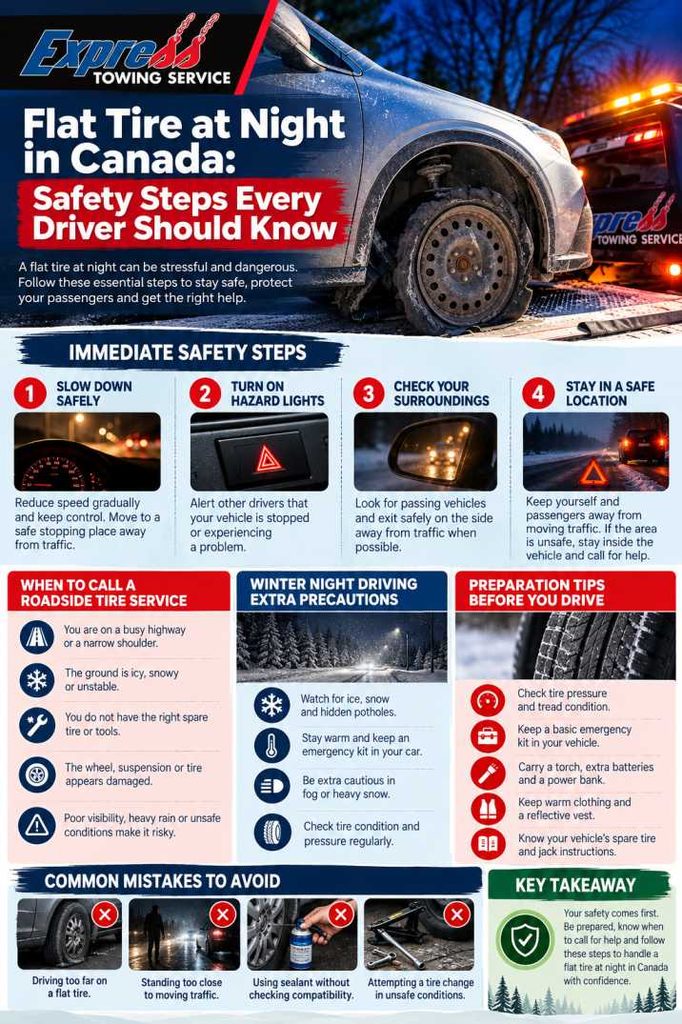
The first priority is not changing the tire. It is finding a safe place to stop and keeping everyone away from moving traffic. If you notice a sudden vibration, thumping sound or loss of tire pressure, avoid sudden steering movements and harsh braking. Reduce speed gradually and move towards a suitable stopping area if conditions allow.
Drivers facing an emergency flat tire change Canada situation should assess their surroundings before deciding what to do next. A vehicle parked in a well-lit car park presents different risks from one stopped beside a highway. Understanding these differences helps you decide whether to use a spare tire, contact roadside assistance or arrange towing.
If your vehicle begins pulling to one side or you hear a repeated thumping noise, remain calm and maintain a firm grip on the steering wheel. Reduce speed gradually without making sudden movements. If possible, move away from moving traffic and stop in a safe parking area, service station or designated stopping location.
Avoid driving on a visibly flat tire simply to reach the nearest exit. Doing so can damage the wheel, affect vehicle control and make the tire unsuitable for repair. If you cannot reach a safer location without taking an unreasonable risk, stop where you can maintain control and assess the situation carefully.
Once stopped, activate your hazard lights to alert approaching drivers. If you are in a car park or residential area, position the vehicle away from entrances, traffic lanes and other moving vehicles whenever possible.
On a highway shoulder, hazard lights can improve visibility, but they do not make the location safe. Avoid standing beside the vehicle to inspect the tire if traffic is passing close by. If your vehicle is exposed to fast-moving traffic, your next step should be to identify a safer position rather than immediately reaching for the jack or spare tire.
Before opening a door, check the traffic around your vehicle and identify a safe route away from the roadway. If the vehicle is stopped in a dangerous location, remaining inside with your seat belt fastened may be safer, provided there is no immediate danger such as fire or another reason to evacuate.
If leaving the vehicle is necessary, use the side away from traffic when possible and move to a protected location well away from the road. Never stand directly behind or in front of a vehicle stopped beside fast-moving traffic. If the situation presents an immediate threat to life or creates a serious traffic hazard, contact emergency services.
Changing a tire may be manageable in a driveway or level parking area, but it can be dangerous on a narrow shoulder after dark. Passing vehicles, unstable ground and poor visibility can increase the risk of injury. A jack can also shift if it is positioned incorrectly or placed on an unsuitable surface.
Avoid attempting a tire change when:
In these circumstances, a professional roadside tire service can assess the situation and determine whether a tire can be changed safely at the location or whether towing is necessary. Getting back on the road quickly should never take priority over personal safety.
If your vehicle is parked securely on firm, level ground, replacing a damaged tire may be reasonable if you have the correct equipment and understand the procedure. Start by consulting the owner’s manual because jack points, wheel-removal instructions and spare-tire restrictions vary between vehicles.
Engage the parking brake, secure the vehicle against movement and keep passengers away from the work area. Never place any part of your body underneath a vehicle supported only by a jack. Follow the manufacturer’s instructions throughout the process.
Some vehicles carry a temporary spare, often called a space-saver. These tires may have restrictions on speed and distance, so check the information supplied by the manufacturer. A temporary spare is intended for limited use and should not automatically be treated as a full replacement for normal driving.
Canadian winter conditions can make a nighttime tire emergency particularly difficult. Snow may conceal potholes and road edges, ice can make it hard to stand securely, and low temperatures can affect your comfort while waiting for help.
If a tire goes flat during winter, assess whether you can reach a safe stopping place without losing control. Avoid kneeling in snow or slush beside a live roadway to inspect the tire. If the vehicle is safely parked but the ground is icy or the temperature makes a tire change unsafe, request roadside assistance instead.
Keep warm clothing, gloves, a winter hat and suitable footwear in the vehicle during colder months. A charged mobile phone, power bank, torch and drinking water can also be useful. These supplies will not remove the risks associated with a breakdown, but they can make an unexpected wait more manageable.
Wet roads and fog can make it difficult for both stranded drivers and approaching vehicles to identify hazards. Rainwater can also conceal potholes that may have caused the puncture. At night, reflections from headlights can make it harder to judge distances and the position of a stopped vehicle.
If you stop in heavy rain, avoid standing where passing vehicles may splash water or lose control. Keep your phone protected from moisture and provide the roadside assistance operator with your location and direction of travel. Explain the weather and visibility conditions when requesting help so the situation can be assessed appropriately.
When requesting emergency flat tire change Canada assistance, accurate information helps the service provider understand the situation and identify the appropriate equipment.
Be ready to share:
If you are unsure of your exact location, use your phone’s map application when it is safe to do so. Highway signs and nearby landmarks may also help. Never walk along a highway or cross moving traffic to find a location marker.
Roadside assistance may involve fitting a suitable spare, inspecting the damage or arranging a tow to an appropriate repair facility. The available options depend on the tire’s condition, the vehicle’s equipment and whether work can be performed safely at the roadside.
A small puncture in the tread may be repairable after proper assessment. However, a torn sidewall, severe structural damage or a tire driven extensively while flat may require replacement. Not every puncture can be repaired safely, and a plug or sealant is not suitable for every type of damage.
Explain what happened before assistance arrives. For example, mention whether the tire lost pressure gradually or deflated suddenly after hitting a pothole. This information may help identify possible damage to the wheel or suspension in addition to the tire itself.
A 24 hour tire change service can be useful when a tire problem occurs late at night, early in the morning or during a holiday. However, availability depends on the location, weather, road conditions and current demand. Confirm that assistance is available in your area and ask whether the service can safely change the tire at your location.
A same day tire change service may be suitable when the vehicle is safely parked and the tire requires replacement or further inspection that day. Same-day availability does not necessarily mean immediate attendance. If the vehicle is stranded in a dangerous position, clearly explain the safety concerns when requesting help.
A tire problem does not always mean that the tire alone is damaged. A hard impact with a pothole or road debris can affect the wheel, tire bead or suspension components. In some cases, a driver may fit a spare and then discover that the vehicle still vibrates or does not handle normally.
Experienced tire change technicians Canada drivers rely on should assess the damaged tire, wheel condition and suitability of the replacement. They should also consider whether the spare is appropriate for the vehicle and whether the wheel fasteners can be secured according to the manufacturer’s specifications.
Drivers should not assume that a tire is safe simply because it holds air after inflation. Sidewall damage, bulges, exposed cords and a badly distorted wheel require professional attention. Similarly, if a tire has been driven while severely underinflated, internal damage may not be visible from the outside.
One common mistake is continuing to drive because the next exit or service station appears close. A fully deflated tire can come apart, damage the wheel and affect vehicle control. If the vehicle becomes unstable, the situation can quickly become more dangerous.
If you cannot reach a safe stopping place without continuing on a damaged tire, prioritise maintaining control and getting out of immediate danger. Once stopped, assess the situation and arrange appropriate assistance rather than attempting to drive a significant distance on the flat.
Drivers sometimes inspect tires or retrieve tools without considering the movement of nearby vehicles. This can expose them to serious danger, particularly on dark highways where approaching motorists may have limited time to react.
Never assume that hazard lights or reflective clothing make a highway shoulder safe. Follow local road-safety guidance, remain in a protected location where possible and avoid walking into traffic to retrieve equipment. If the location is unsafe, wait for appropriate assistance.
Portable inflators and tire sealants can help in certain situations, but they are not universal solutions. Some vehicles use run-flat tires, while others have a temporary spare or a tire mobility kit. Certain sealants may also be unsuitable for particular types of tire damage or vehicle systems.
Check the owner’s manual before using a sealant or inflator. Do not attempt to reinflate a tire with obvious structural damage or continue driving if it will not hold pressure. Temporary repair products should only be used when permitted by the manufacturer’s instructions and appropriate for the specific damage.
An emergency kit can improve visibility, communication and comfort while you wait for help. The goal is to prepare for an unexpected breakdown without encouraging a risky roadside repair.
Consider carrying the following items:
Check your spare tire’s condition periodically, including its pressure and any manufacturer-specific restrictions. An unused spare can still be unsuitable if it is damaged, underinflated or too old. If your vehicle does not carry a spare, understand the available alternatives before starting a long journey.
Preventive maintenance cannot eliminate every puncture, but it can reduce the likelihood of tire-related breakdowns. Check tire pressure when the tires are cold and follow the vehicle manufacturer’s recommended pressures, usually listed on the driver’s door placard or in the owner’s manual.
Inspect the tread for uneven wear, embedded objects, cuts and bulges. Recurring pressure loss may indicate a puncture, damaged valve or wheel-sealing problem. If a tire repeatedly needs air, arrange a professional inspection instead of simply topping it up before every trip.
Before a long drive, particularly in winter, confirm that your tires are suitable for the expected road conditions. Adequate tread, correct inflation and appropriate seasonal tires can improve vehicle control, although they cannot prevent every road hazard.
When a tire goes flat at night, drivers often feel pressure to resolve the problem immediately. A more reliable approach is to consider three questions: Can the vehicle be brought to a safe stop? Is the current location safe enough for any repair work? Can the tire be replaced without creating additional risk?
For example, a driver who discovers a puncture in a well-lit car park may be able to wait safely for a technician or change a suitable spare. The same driver on a narrow highway shoulder in freezing rain faces a very different situation. Road conditions, visibility and available space should determine the response.
Drivers should also understand that fitting a spare does not automatically make the vehicle ready for unrestricted travel. Follow any speed and distance limits for the spare, check the tire pressure and arrange a proper inspection or replacement as required. If the vehicle vibrates, pulls to one side or displays a tire-pressure warning after the change, stop somewhere safe and seek further assessment.
Express Towing Services can be considered when arranging assistance for a tire-related breakdown. When contacting the service, explain your location, vehicle details, tire condition and any immediate safety concerns. This information helps clarify whether a roadside tire change is appropriate or whether towing may be necessary.
The most important lesson is that a quick repair should never take priority over personal safety. Understanding your vehicle, maintaining your tires and knowing how to request assistance can help you respond more confidently when an unexpected puncture occurs after dark.
Reduce speed gradually, maintain steering control and move to a safe stopping location if possible. Switch on your hazard lights and assess the surroundings before exiting. If the vehicle is on a narrow shoulder beside fast-moving traffic, do not attempt to change the tire there. Move to a protected location if it is safe to do so, and contact roadside assistance. Call emergency services if there is an immediate threat to life or a serious traffic hazard.
Driving on a completely flat tire is generally unsafe because it can damage the wheel, affect vehicle control and destroy the tire. Some vehicles have run-flat tires designed to travel a limited distance under specific conditions, but their restrictions depend on the tire and vehicle manufacturer. Check the owner’s manual and do not assume that an ordinary tire can be driven on safely. If you cannot reach a safe location without risking further damage, stop and arrange assistance.
Availability varies by location, weather, road conditions and service coverage. Some areas have access to overnight roadside assistance, while remote highways and rural communities may have fewer available services. When calling, provide your location, direction of travel, vehicle details and the condition of the tire. Confirm whether the service can change the tire at your location or whether towing will be necessary.
Use tire sealant only when the vehicle manufacturer’s instructions permit it and the damage is suitable. Sealants may help with certain small tread punctures, but they cannot resolve every puncture, sidewall tear or structural failure. Some vehicles have specific requirements for tire mobility kits, and sealant can affect subsequent inspection or repair procedures. If the tire is visibly damaged or will not hold pressure, arrange professional assistance instead.
Check tire pressure, tread condition and tire suitability before winter journeys. Keep a torch, charged phone, power bank, warm clothing, gloves and suitable emergency supplies in the vehicle. If your car carries a spare, check its pressure and condition as well. Plan longer journeys around weather and road conditions, and know how to contact roadside assistance. These precautions can make an unexpected breakdown easier to manage, but if the stopping location is unsafe, wait for appropriate help rather than attempting a roadside repair.


