

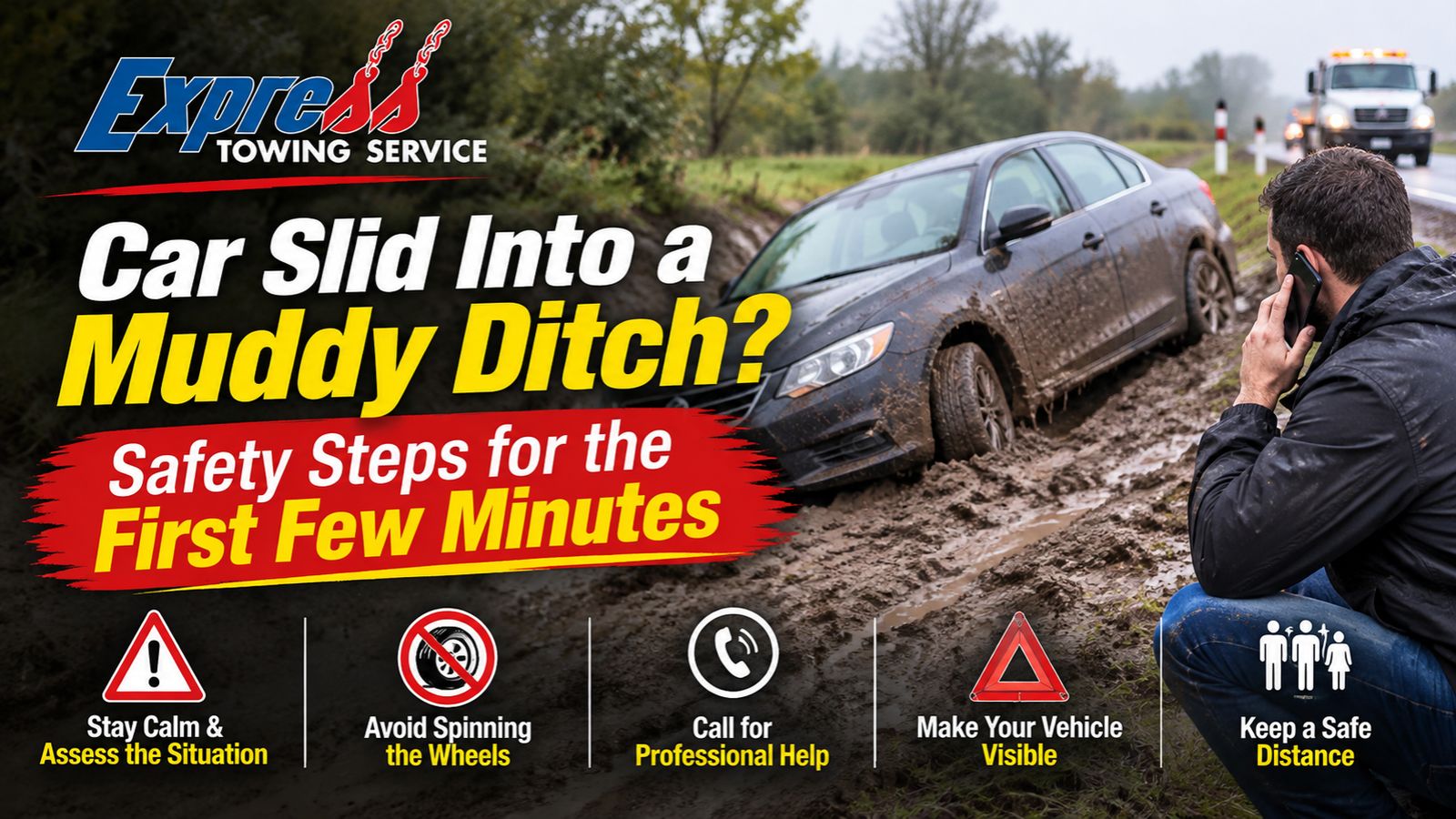
The back end slips. You correct the steering, but the soft shoulder gives way, and the car slides sideways into the ditch. Everything goes quiet except your heartbeat.
When your Car Slid Into a Muddy Ditch, the first few minutes shape everything that follows. The right moves keep you safe and protect your vehicle. The wrong moves, like flooring the gas or accepting a risky pull from a stranger, can turn a scare into a real accident.
This guide walks you through exactly what to do, step by step. It also explains when a professional mud winching and recovery service becomes the safest way out.
You’ll learn how accident recovery winching differs from a simple tow, and what to look for in an off-road vehicle winching service Canada drivers can trust.
Ditch slides rarely come from reckless driving. They usually come from road conditions that change faster than drivers expect.
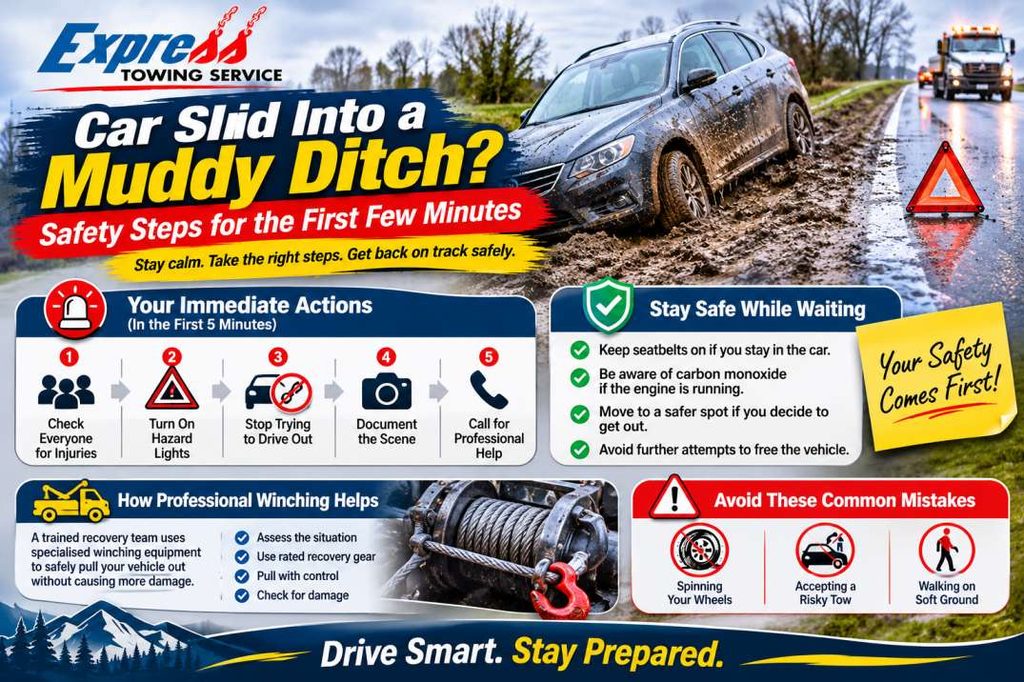
Use this checklist to keep your head clear. Work through it in order.
| Step | What to Do | Why It Matters |
|---|---|---|
| 1 | Check everyone for injuries | People always come before the vehicle |
| 2 | Switch on hazard lights | Makes your car visible to other drivers |
| 3 | Decide whether to stay in or get out | Protects you from traffic and an unstable car |
| 4 | Stop trying to drive out | Prevents deeper ruts, tipping and damage |
| 5 | Check the exhaust if the engine runs | Prevents carbon monoxide build-up |
| 6 | Photograph the scene | Supports insurance and any report |
| 7 | Call the right help | Gets the right equipment the first time |
Ask each passenger how they feel, and check yourself too. A sudden slide can cause neck strain, bumps and shock that people don’t notice right away. If anyone is hurt, call 613-227-1111 immediately. Also call if your car blocks the road, leans badly or sits near water.
Turn on your hazard lights straight away. If it is dark or snowing, switch on your interior light too, so passing drivers notice someone inside. Only place reflective triangles if you can do so without walking along live traffic.
On a busy road, staying belted inside a stable car is often the safer choice. Leave the vehicle if you smell fuel, see smoke, notice rising water or feel the car shifting. When you get out, use the side away from traffic and the downhill slope, and move well clear of the car.
This step feels hardest, but it matters most. Spinning wheels dig deeper ruts, and a tilted car can tip further when the tires suddenly grab. Hard acceleration can also overheat the transmission. If one gentle attempt fails, switch off the engine and wait for proper help.
Many drivers keep the engine running for heat. Before you do, make sure mud or snow does not block the tailpipe. A blocked exhaust can push carbon monoxide into the cabin, and you cannot smell it. Crack a window slightly and run the engine only in short bursts.
Take photos of the car’s position, the road edge, the tire tracks and any damage. These pictures help your insurance claim and protect you if questions come up later. Depending on the damage and your province’s rules, you may also need to report the incident to police.
A ditch recovery takes more than hooking up a chain and pulling. A trained mud winching and recovery service treats each job as a planned operation, because a tilted car sitting in soft mud can easily roll or twist.
The operator first studies how the car sits. They check the angle, how deep each wheel has sunk and whether the frame rests on the ground. They also look for hidden hazards, such as culverts, rocks or water under the mud. This assessment decides the pulling direction and equipment.
Here, accident recovery winching shows its value. The operator attaches to rated recovery points, never to weak tie-down hooks or suspension parts. They may use a snatch block to change the pulling angle and reduce strain. The pull happens slowly, keeping the car upright as it climbs back onto solid ground.
Once the car sits back on the road, a good operator checks for obvious damage. They look at the tires, steering alignment, fluid leaks and underbody. If the car seems unsafe to drive, they recommend a flatbed tow instead of risking the trip home.
Picture a common case. A driver slides into a roadside ditch during an early snowfall, and the car sits at a steep tilt. A passerby offers to pull it out with a rope and a pickup. The driver politely declines and waits for a trained operator. The pull later reveals a damaged tie rod, which a rough yank could have snapped completely.
A ditch beside a paved road differs from a stuck truck on a remote trail. Trail recoveries often happen far from solid anchor points and deep in thick mud. Operators may anchor to large trees using tree-saver straps, or use ground anchors where no trees stand nearby. Drivers who explore back roads and trails should save an off-road vehicle winching service Canada contact before every trip, since mobile signal can fade in remote areas.
Ditch slides happen at night, in storms and on quiet roads. A 24 hour winch out service Canada drivers rely on should send trained operators with proper rated gear, not just a truck and a chain.
When you call, share these details clearly:
Our operators at Express Towing Services handle ditch recoveries throughout the colder months. These habits make a real difference.
When your Car Slid Into a Muddy Ditch, your first job is safety, not speed. Check for injuries, make yourself visible and stop trying to drive out. Watch your exhaust in cold weather, and document the scene for your records.
A professional mud winching and recovery service protects both your car and everyone around it. Express Towing Services brings trained operators, rated equipment and a calm, safety-first approach to every ditch recovery.
For crashes and slides that leave cars tilted or damaged, our accident recovery winching team works slowly and carefully to keep your vehicle upright. We also provide an off-road vehicle winching service Canada drivers can count on for trails and back roads.
Save the Express Towing Services number in your phone today, so help is always one call away.
One gentle attempt in a straight line is usually fine if the car sits level. If the wheels spin, the car leans or the frame rests on the ground, stop right away. Spinning digs deeper ruts and can tip a tilted car further. It can also overheat your transmission. At that point, a professional mud winching and recovery service offers the safest way out without extra damage.
It is usually not safe. Chains have no stretch, so they can snap under sudden load and fly back with serious force. Strangers also tend to hook onto bumpers, tie-down points or suspension parts, which can bend or tear off. Politely decline and wait for trained help. Professional operators use rated gear and controlled accident recovery winching to protect both people and vehicles.
On a busy road, staying belted inside a stable car is often the safer option, because passing traffic poses the biggest danger. Get out if you smell fuel, see smoke, notice rising water or feel the car shifting. Exit on the side away from traffic, and move well clear. In cold weather, keep the exhaust clear and run the engine only in short bursts.
Operators first study the angle and stability of the car. They attach to rated recovery points and choose a pulling direction that keeps the car upright. Snatch blocks help them adjust the angle and reduce sudden strain. The pull happens slowly, with constant checks. A good 24 hour winch out service Canada drivers trust follows this careful process every time, whatever the weather or road conditions.
Trail recoveries often need more planning than roadside ditches. Vehicles sink deeper, anchor points sit farther away and mobile signal may be weak. Operators may use tree-saver straps or ground anchors to create a safe pull. If you explore back roads or trails, save an off-road vehicle winching service Canada contact before you leave, and share your route with someone you trust.


