

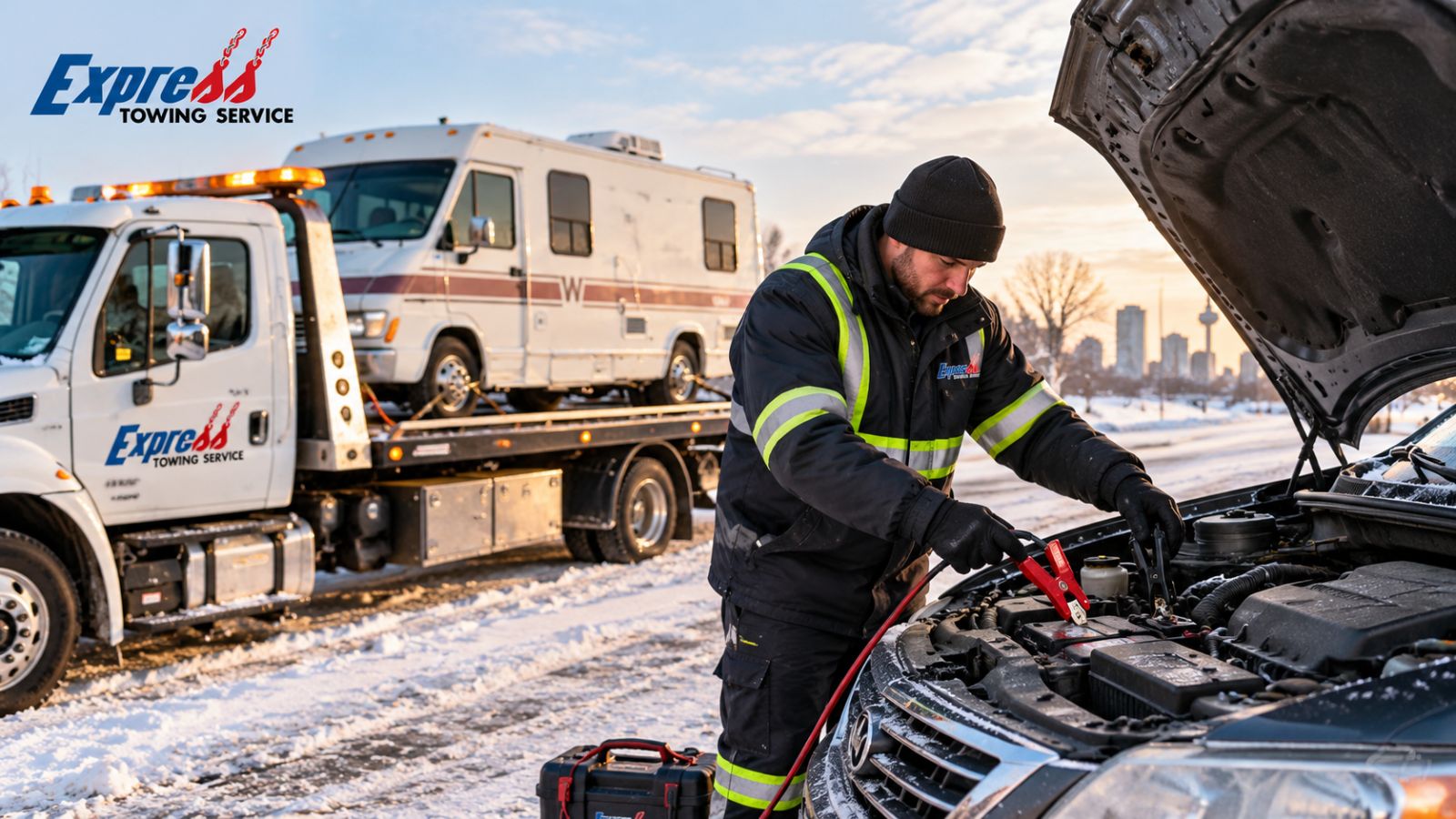
A vehicle that refuses to start can turn an ordinary morning into a serious inconvenience. You may be parked outside your home, sitting in a shopping-centre car park, preparing to leave work, or stranded somewhere unfamiliar. You turn the key or press the start button and hear a click—or nothing at all.
A weak or discharged battery is one of the most common reasons a vehicle will not start. In these situations, a battery boost service Canada drivers can rely on can provide a practical way to get the vehicle running again without immediately replacing the battery.
However, boosting a vehicle is not simply a matter of connecting two cables and hoping for the best. Modern vehicles have sensitive electrical systems, different battery configurations, and increasingly complex electronics. Incorrect connections can cause damage, while repeatedly boosting a failing battery may only postpone a larger problem.
This guide explains what a professional battery boost involves, when to call for assistance, what drivers should do before help arrives, and what to check once the vehicle starts.
Most drivers do not think about their vehicle battery until the engine fails to start.
A battery can gradually lose its ability to hold a charge without producing obvious symptoms. In other cases, the warning can be more noticeable.
Common causes of a dead or weak battery include:
Cold Canadian weather deserves particular attention.
Low temperatures can reduce a battery’s available starting power, while engine oil can become more resistant to movement. This combination can make starting an engine more demanding.
A battery that seemed acceptable during mild weather may therefore struggle when temperatures fall sharply.
A professional battery boost is a roadside assistance procedure intended to provide temporary electrical power to a vehicle with a discharged battery so the engine can start.
The technician generally uses suitable booster equipment and connects it correctly to the vehicle’s battery or designated jump-start terminals.
Once the vehicle starts, the boost itself does not necessarily mean the underlying problem has been solved.
That distinction is important.
If the battery was discharged because someone accidentally left the lights on, the boost may be all that is needed.
If the battery is old, damaged, or unable to retain a charge, the vehicle may stop starting again later.
A professional technician should therefore consider the circumstances rather than treating every dead battery as identical.
A good car battery service starts with understanding why the vehicle needs assistance.
Before boosting, a technician may consider:
This initial assessment matters because the correct procedure can vary between vehicles.
Modern vehicles may have dedicated jump-start terminals rather than requiring direct connection to the battery itself. Some vehicles also contain sensitive electronic systems that require appropriate procedures.
One of the most important principles during a boost is maintaining correct polarity.
The positive and negative connections must be correctly identified.
A reversed connection can potentially cause serious electrical problems.
This is one reason professional assistance is preferable when a driver is uncertain about the correct procedure.
An emergency battery boost for vehicles can be appropriate when the primary problem appears to be a discharged battery and the vehicle needs to be started at the roadside, at home, or in a parking area.
Typical situations include:
This is one of the simplest scenarios.
If the headlights or interior lights were accidentally left on for several hours, the battery may have discharged enough to prevent the engine from starting.
After a successful boost, the vehicle may operate normally once the battery receives sufficient charging.
A vehicle that remains unused for days or weeks can experience battery discharge, particularly if it has electrical systems that continue consuming a small amount of power while parked.
A battery that is already weak can struggle significantly during very cold weather.
If the vehicle produces a slow cranking sound or clicking noise in cold conditions, battery condition should be considered.
Automotive batteries have a finite service life. The exact lifespan depends on battery type, climate, vehicle use, maintenance, and other conditions.
If the vehicle repeatedly requires boosts, replacing or properly testing the battery may be more appropriate than continuing to request roadside assistance.
When discussing battery boost vehicle jumpstart Canada services, drivers often want to know what actually happens when the technician arrives.
The process generally involves several stages.
The technician first confirms that a discharged battery appears to be the likely reason for the no-start condition.
A vehicle that does not start could have another problem, such as a starter issue, fuel problem, immobilizer fault, or charging-system failure.
The technician locates the appropriate positive and negative connection points.
On some vehicles, these are directly at the battery. On others, manufacturer-designated terminals are used.
The equipment is connected using the correct procedure for the vehicle.
The exact process can vary according to the vehicle and equipment being used.
The vehicle is then started.
If the battery is merely discharged and the rest of the starting system is functioning properly, the engine may start relatively quickly.
A successful start does not automatically mean the vehicle is fixed.
The technician may recommend further battery or charging-system assessment if the circumstances suggest a recurring problem.
When a driver is stranded, speed matters.
But good roadside service also requires appropriate judgment.
Consider two situations.
In the first, a driver left an interior light on overnight. The vehicle starts normally after a boost and has no history of battery problems.
In the second, a driver has needed three boosts during the previous month. The battery is several years old, and the engine has been increasingly slow to start.
Both vehicles may start after a boost.
But the second vehicle requires further investigation.
A professional approach recognizes this difference instead of treating the successful engine start as the end of the problem.
A boost can get you moving, but certain symptoms suggest that the battery or charging system needs attention.
Watch for:
If the vehicle starts with a boost but soon develops another starting problem, don’t assume another boost is always the solution.
The underlying electrical system may need inspection.
If your vehicle will not start, take a moment to assess the situation safely.
If the vehicle is in a dangerous position, prioritize personal safety.
Use hazard lights if they are functioning and move to a safe location when possible.
Repeatedly attempting to start a vehicle with a severely discharged battery can drain remaining battery capacity without solving the problem.
If safe to do so, consider whether:
These details can help the technician understand what happened.
When requesting roadside assistance, provide a precise location, nearby landmarks, parking area information, and vehicle details where possible.
This can make it easier for the technician to locate you.
Incorrect connections can damage electrical components.
If you are not completely confident about the correct procedure, professional assistance is the safer option.
A vehicle that won’t start does not automatically have a dead battery.
Possible causes can include:
If a proper boost does not resolve the problem, further diagnosis may be necessary.
If your vehicle needs another boost shortly after receiving one, consider why.
Repeated boosting can become a cycle if the underlying battery or charging issue remains unresolved.
Some roadside providers may offer battery boosting as part of a broader service, while others may provide additional battery testing or replacement options.
Confirm what is included before requesting assistance.
There are circumstances in which an experienced driver may know how to jump-start a vehicle correctly.
However, professional help has several practical advantages.
A trained technician can assess the situation, use appropriate equipment, identify correct connection points, and recognize when the vehicle may have a problem beyond a discharged battery.
This is especially relevant for modern vehicles with complex electronics.
If you are uncertain about your vehicle’s jump-start procedure, checking the manufacturer’s instructions is preferable to guessing.
Getting the engine running is only the first step.
If the vehicle starts after a boost, pay attention to how it behaves.
If the vehicle starts normally later, the original discharge may have been caused by something temporary.
A warning light may indicate a charging-system issue and should not be ignored.
Slow cranking can indicate that the battery remains weak or that another problem is affecting the starting system.
If the vehicle starts but then stalls or loses electrical power, the issue may extend beyond the battery.
In these situations, additional roadside diagnosis may be necessary.
Canadian drivers face environmental conditions that can place additional demands on vehicle batteries.
Cold temperatures can reduce the amount of starting power available from a battery. At the same time, cold conditions can increase the effort required to turn over an engine.
This means a marginal battery may fail when temperatures drop even if it seemed acceptable previously.
Drivers who regularly park outside during winter should pay attention to warning signs rather than waiting for a complete failure.
Practical habits include:
When comparing a battery boost service Canada drivers may use, look for practical indicators of professionalism.
The provider should explain what service is being provided and whether additional charges may apply.
Professional equipment should be suitable for modern vehicles and used according to the vehicle’s requirements.
Experience matters because not every no-start condition is identical.
The provider should be able to receive and use your location details effectively.
Ask whether the quoted price includes the boost itself, travel, after-hours service, or other charges.
A trustworthy provider should not promise that every vehicle will start simply because a boost is attempted.
Sometimes the battery is too damaged, or the actual problem lies elsewhere.
A vehicle that is increasingly slow to start may be giving you an early warning.
Needing assistance repeatedly is a reason to investigate the battery and charging system.
Canadian drivers may benefit from keeping practical roadside items such as:
Read the owner’s manual so you know whether your vehicle has specific jump-start procedures or designated terminals.
This information can be extremely useful when you’re under pressure.
A dead battery can happen at home, at work, in a parking lot, or during a long-distance journey. When it does, professional assistance can turn a stressful no-start situation into a manageable roadside problem.
A reliable battery boost service Canada drivers can use should involve more than simply connecting a booster and leaving. Proper equipment, correct connection procedures, practical assessment, clear communication, and appropriate follow-up advice all contribute to a safer and more useful service.
Express Towing Services understands that a vehicle that will not start is rarely a convenient problem. Whether the issue occurs during a cold Canadian morning or after a long day at work, getting the vehicle assessed and moving again is the immediate priority.
At the same time, drivers should remember that a boost is often a temporary solution. If the battery repeatedly goes flat, the vehicle starts slowly, or warning signs appear after the boost, the underlying cause should be investigated.
The best roadside decision is not always simply to get the engine running. It is to understand why it stopped starting in the first place and take the appropriate next step.
A professional battery boost supplies temporary electrical power to a vehicle with a discharged battery so that the engine can start.
The technician identifies the correct connection points and uses appropriate booster equipment according to the vehicle’s requirements. Once the engine starts, the technician may also consider whether the battery or charging system shows signs of a deeper problem.
A successful boost does not necessarily mean the battery is healthy.
If the engine does not crank, cranks very slowly, or produces clicking sounds while the vehicle’s electrical systems appear weak, a discharged battery may be the cause.
However, no-start problems can also come from the starter, alternator, ignition system, fuel system, immobilizer, or other components.
If a boost does not work, additional roadside diagnosis may be required rather than repeatedly attempting to start the vehicle.
Modern vehicles can generally be boosted when the correct manufacturer procedure is followed, but their electrical systems can be more complex than those of older vehicles.
The correct connection points and procedures should be followed carefully. If you are uncertain, professional assistance is preferable to guessing.
Repeated battery failure can have several causes.
The battery may be old or unable to hold a charge. The alternator may not be charging correctly. An electrical component may be drawing power while the vehicle is parked, or the vehicle may simply be used infrequently.
If the battery repeatedly requires a boost, the underlying cause should be investigated rather than relying on another jump-start each time.
Cold weather can reduce the available starting power of a battery and increase the effort required to start an engine.
A battery that is already weak may therefore fail during very cold conditions even if it appeared acceptable previously.
If your vehicle becomes progressively slower to start during cold weather, consider having the battery and charging system checked before the problem becomes a roadside emergency.


