

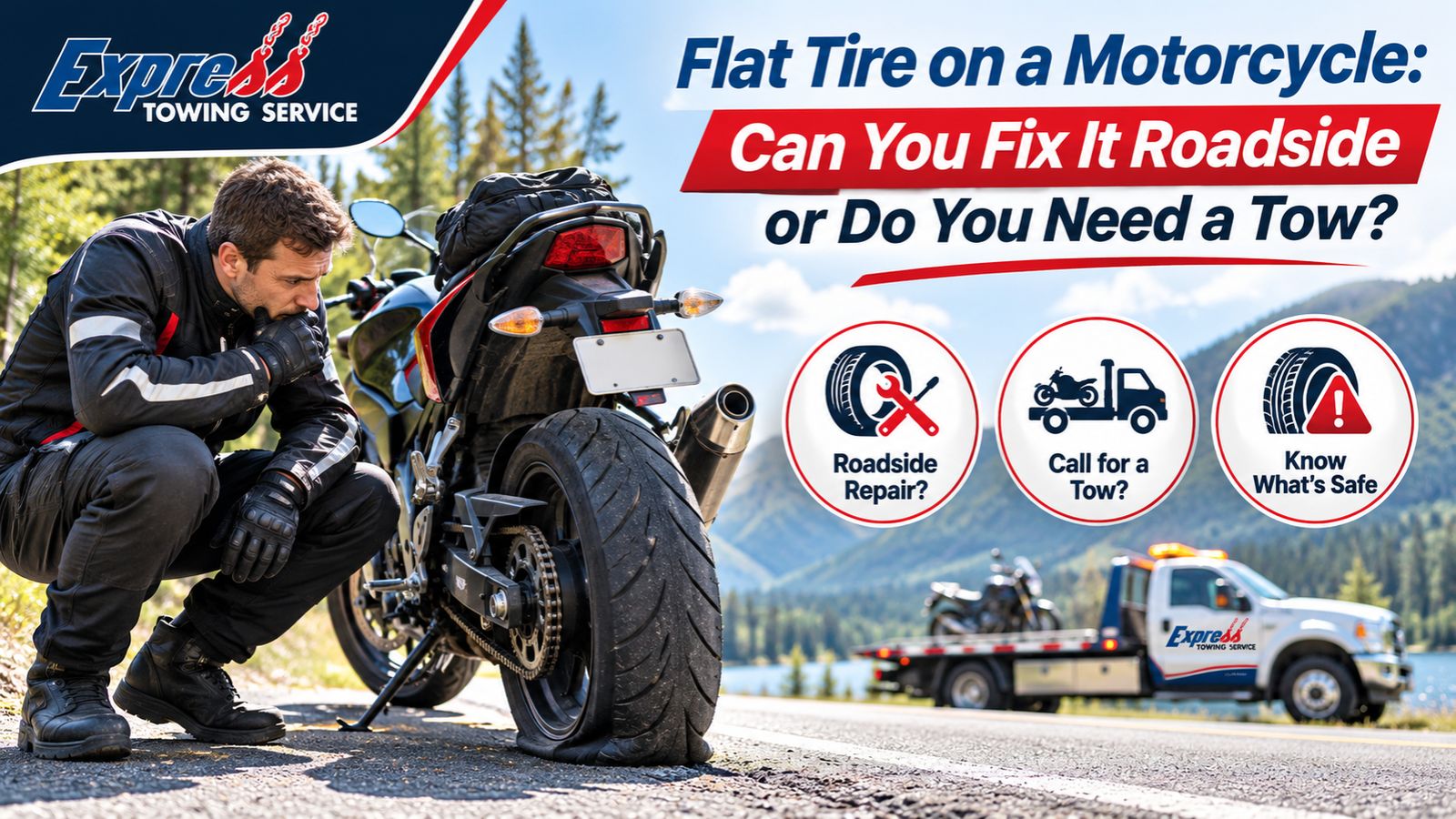
You feel it before you see it. The rear end starts to weave, the steering feels heavy, and the bike no longer tracks straight. You ease off the throttle, pull over and look down at a tire that has gone soft.
A Flat Tire on a Motorcycle feels far more serious than one on a car. You have only two contact patches, and each one carries your balance, braking and steering. The wrong choice at the roadside can turn a small puncture into a crash.
So should you fix it yourself or call for professional motorcycle towing? The honest answer depends on your tire type, where the damage sits and how confident you feel with a repair kit.
This guide helps you make that call with a clear head. It also explains when an affordable motorcycle towing service saves you money in the long run, and what to do if you break down far from home and need 24/7 motorcycle towing Canada riders can rely on.
A car with a flat still sits on three good tires. A motorcycle does not have that safety net. When air pressure drops, the tire’s shape changes, and the bike’s handling changes with it.
Do not brake hard or make sudden moves. Hold the handlebars firmly and keep the bike upright and straight. Roll off the throttle smoothly and let the bike slow on its own. Use gentle rear brake if needed, then move to the shoulder or a safe pull-off with your hazard lights on.
Before you open any repair kit, check two things: your tire type and the location of the damage.
| Situation | Roadside Fix Possible? | Best Move |
|---|---|---|
| Tubeless tire, small nail or screw in the centre tread | Often yes | Plug it, inflate it and ride slowly to a tire shop |
| Tubeless tire, puncture near the shoulder or sidewall | No | Call for a tow, since sidewall repairs are unsafe |
| Tube-type tire (common on spoked wheels) | Rarely | Tow it, because the wheel usually has to come off |
| Large cut, gash or torn tread | No | Tow it, as no roadside kit can seal this safely |
| Tire came off the rim or the rim is bent | No | Tow it on a proper motorcycle setup |
| Unsure of the cause or feeling shaken | Not worth the risk | Tow it and let a shop inspect it properly |
Most modern sport, touring and cruiser bikes with cast wheels run tubeless tires. Many spoked wheels use inner tubes, though some newer spoked designs run tubeless. Check your owner’s manual or look for “tubeless” printed on the sidewall. Knowing this ahead of time saves you from guessing at the roadside.
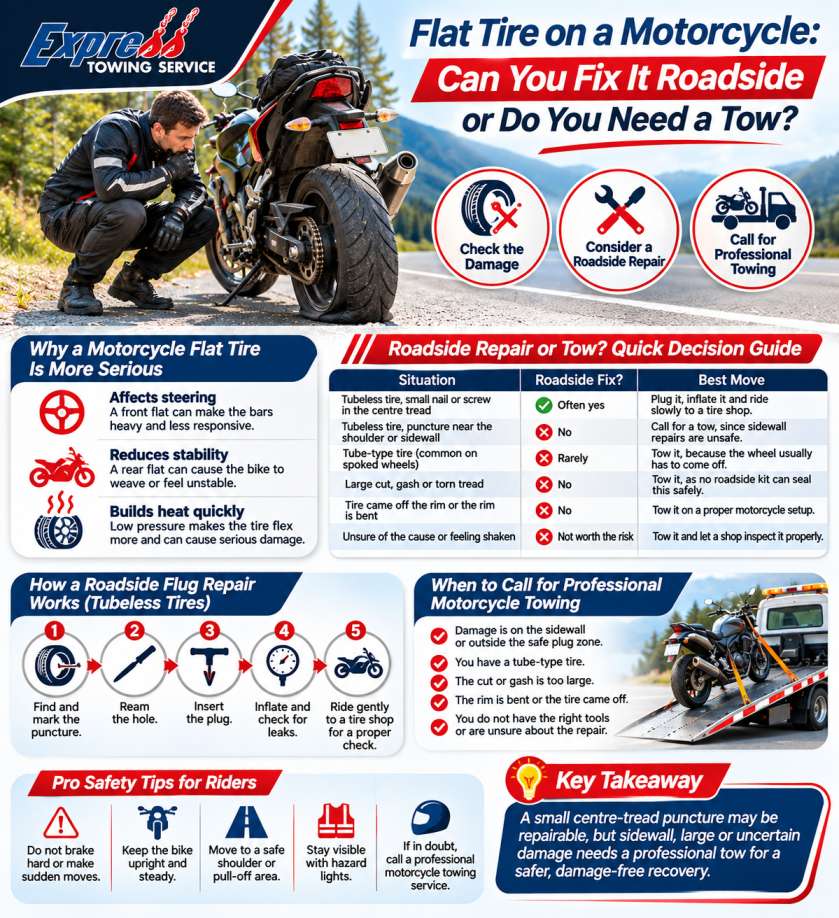
If your puncture sits in the centre tread of a tubeless tire, a plug kit can get you to a shop. Here is the usual process.
Picture a common case. A rider on a touring bike picks up a screw on a gravel shoulder. They plug it, inflate it and ride carefully to a tire shop. The shop then advises a full tire replacement, because the screw entered at an angle and damaged the inner cords. The plug did its job, but only as a bridge to proper repair.
Sometimes the safest repair is no repair at all. Calling for professional motorcycle towing makes sense when the damage sits outside the safe plug zone, when you run tube-type tires or when you lack the right tools.
A motorcycle cannot be towed like a car. Lifting one wheel and dragging the bike risks bent forks, scratched fairings and a damaged drivetrain. Trained operators use wheel chocks to hold the front tire steady. They use soft straps on solid frame points, and they never strap across fragile parts like levers, mirrors or plastic panels.
Good operators also avoid compressing the front forks too far when tightening straps. Over-compressed forks can damage seals during a long ride on a truck deck.
Low cost and good care can go together. An affordable motorcycle towing service should still use proper chocks, soft straps and a flatbed or motorcycle-specific setup. Ask how they secure the bike before you hand over your keys. A trustworthy operator explains their method openly and welcomes your questions.
Breakdowns also happen at night, in bad weather and on long empty stretches between towns. That is why many riders save a 24/7 motorcycle towing Canada contact before every road trip. It removes the stress of searching for help while standing on a dark shoulder.
Our team at Express Towing Services handles motorcycles of every size, from light commuters to heavy touring bikes. These habits help riders avoid trouble.
A Flat Tire on a Motorcycle does not always mean a tow, but it always calls for a clear decision. Centre-tread punctures on tubeless tires often take a plug well. Sidewall damage, tube-type tires and large cuts need proper help.
When the damage goes beyond a safe roadside fix, professional motorcycle towing protects both you and your bike. Express Towing Services uses wheel chocks, soft straps and careful loading for every motorcycle we move.
Looking for an affordable motorcycle towing service that treats your bike with care? Express Towing Services offers honest communication, transparent service and a team that understands bikes.
Save our number before your next ride. When you need 24/7 motorcycle towing Canada riders trust, our team is ready to help you get home safely.
Most tire experts treat a plug as a temporary fix, not a permanent one. A plug seals the hole from outside, but it cannot show whether the inner cords suffered damage. After plugging a Flat Tire on a Motorcycle, ride gently to a tire shop for an inspection. The shop may patch the tire from inside or recommend a replacement. Your safety depends on that tire, so do not skip this check.
The sidewall flexes every time the tire rolls, corners or hits a bump. That constant movement can push a plug loose without warning, and a sudden loss of air at speed is extremely dangerous on two wheels. Sidewall damage also weakens the tire’s structure, which no roadside kit can restore. If the puncture sits near the shoulder or on the sidewall, call for professional motorcycle towing instead of risking a repair.
Look at the tire sidewall first. Tubeless tires usually show the word “tubeless” printed on them. Cast alloy wheels mostly run tubeless tires, while many spoked wheels use inner tubes. Your owner’s manual confirms the exact setup. Tube-type flats usually need the wheel removed, which is hard to do on a roadside. In that case, an affordable motorcycle towing service is often the faster and safer option.
Towing should not damage your bike when trained operators handle it correctly. Problems usually come from poor methods, such as dragging the bike on one wheel, strapping across levers or over-compressing the front forks. A proper setup uses a wheel chock, soft straps on solid frame points and a flatbed or motorcycle-specific carrier. Before loading, ask the operator how they secure the bike. A professional will gladly explain every step.
Get safe first. Move well off the road, switch on your hazard lights and wear anything reflective you carry. Avoid repairs in poor light unless the damage is clearly a simple centre-tread puncture. Instead, call for 24/7 motorcycle towing Canada riders trust, and share your location, bike model and the tire problem. Stay visible, keep your phone charged and wait away from passing traffic until help arrives.


