

A car battery can fail without much warning. You might turn the key and hear a clicking sound, press the start button and get no response, or find that your dashboard lights come on while the engine refuses to start. These situations are particularly inconvenient when you’re parked outside your home, at work, in a shopping centre car park or on the roadside during cold Canadian weather.
A professional battery boost service Canada drivers can turn to helps address this common problem by providing assistance when a vehicle’s battery has insufficient power to start the engine. Rather than attempting a jump-start without the correct equipment or understanding your vehicle’s requirements, you can request professional assistance to help determine the appropriate next step.
For drivers dealing with an unexpected starting problem, understanding how a battery boost works, what causes battery failure and when a boost may not be enough can make a stressful situation easier to manage.
Express Towing Services is the brand featured in this guide. Below, we’ll explain when a battery boost may help, what to expect from professional assistance and how to reduce the likelihood of another unexpected battery problem.
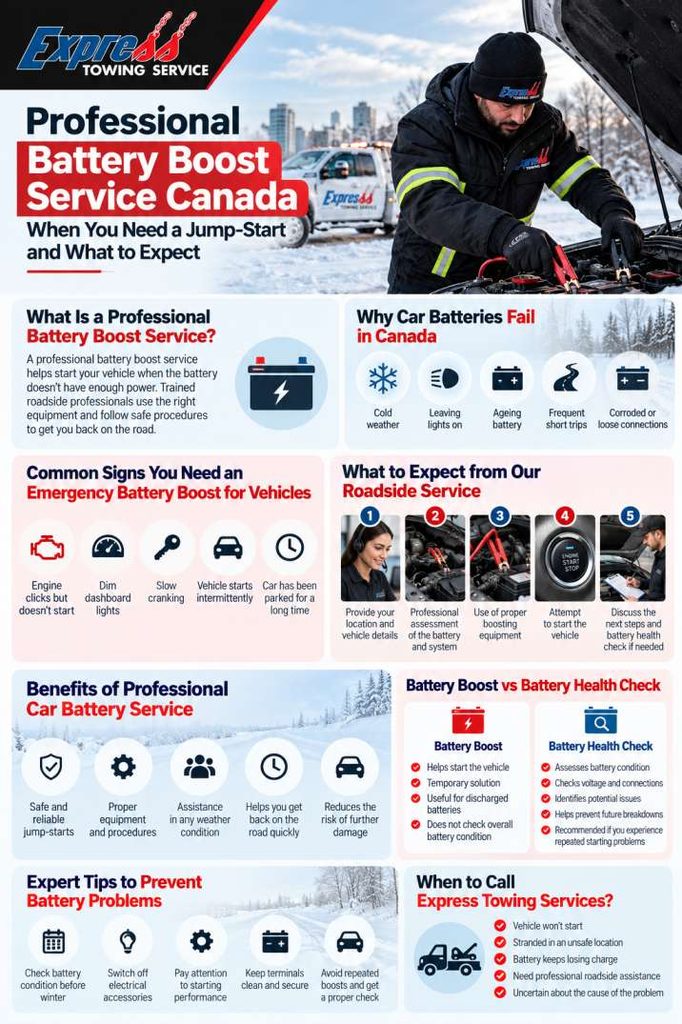
A professional battery boost is a roadside assistance service designed to help start a vehicle when its battery cannot provide sufficient power. A trained roadside professional uses suitable boosting equipment and follows the vehicle manufacturer’s recommended procedure to attempt to start the engine.
A typical vehicle battery supplies the electrical energy needed to operate the starter motor and essential electrical systems. When the battery becomes discharged, the starter may not receive enough power to turn the engine over.
A boost provides temporary starting assistance. However, it does not automatically repair a worn-out battery, resolve a charging-system fault or guarantee that the vehicle will continue running reliably.
Professional assistance can be particularly useful when:
The appropriate response depends on the symptoms, the condition of the battery and the vehicle’s design.
Canadian weather can place considerable demands on vehicle batteries. Cold temperatures reduce a battery’s ability to deliver starting power, while engines may require more effort to start in winter conditions. A battery that performs adequately during mild weather may struggle when temperatures fall.
However, cold weather is not the only reason a vehicle might need a boost.
Low temperatures affect the chemical reactions inside a battery, reducing the power available for starting. At the same time, cold engine oil can increase the resistance the starter motor must overcome.
This combination can make winter mornings particularly challenging for older or partially discharged batteries.
Headlights, interior lights, infotainment systems and other electrical accessories can gradually discharge a battery when the engine is off.
Some vehicles automatically switch certain accessories off, but this feature should not be treated as a guarantee against battery drain.
Vehicle batteries gradually lose their ability to hold and deliver a charge. Their service life varies according to battery type, climate, driving patterns and maintenance.
If your battery is several years old and the engine has become increasingly difficult to start, a professional assessment may help determine whether it needs replacement rather than another boost.
Repeated short trips may not provide sufficient time for the vehicle’s charging system to replenish the energy used during starting. This can contribute to a persistently undercharged battery, particularly during winter.
Corrosion, loose terminals or damaged cables can interfere with the flow of electrical current. Even a battery that retains some charge may struggle to deliver sufficient power if its connections are compromised.
A boost may not solve the underlying problem, so visible damage or persistent starting issues warrant further inspection.
An emergency battery boost for vehicles may be appropriate when the engine fails to start because the battery is discharged and the battery itself is safe to boost.
Recognising common symptoms can help you explain the situation when requesting assistance.
Repeated clicking can indicate insufficient battery power, although other electrical or starter-related faults can produce similar symptoms.
If the dashboard lights illuminate but the starter struggles to turn the engine, a discharged battery is one possible explanation.
Dim dashboard lights, slow power windows or headlights that appear unusually weak may indicate a battery or electrical-system issue.
These signs are useful clues, but they do not confirm the cause on their own.
A vehicle that starts normally one day but struggles the next may have a weakening battery, poor electrical connections or a charging-system problem.
Repeated starting difficulties should not be dismissed simply because the engine eventually starts.
Vehicles left unused for extended periods can experience battery discharge. Electrical systems may continue drawing small amounts of power even when the vehicle is switched off.
If the vehicle will not start after a long period of inactivity, a professional can help assess whether a boost is appropriate.
A dead battery can become a safety concern when it leaves you unable to move your vehicle from a vulnerable location. If you are near moving traffic, prioritise your personal safety and contact suitable roadside assistance.
Do not stand in a traffic lane or attempt battery work in a position that exposes you to passing vehicles.
Knowing what happens during a professional roadside visit can help you prepare and communicate the problem clearly.
When contacting Express Towing Services, provide your location as accurately as possible and describe what happens when you attempt to start the vehicle.
Useful details include:
Clear information helps the service provider understand the situation and determine what assistance may be appropriate.
Before attempting a boost, the battery and surrounding area should be checked for obvious hazards. A swollen, cracked, leaking or potentially frozen battery should not be treated as an ordinary jump-start situation.
The vehicle’s battery location and boosting instructions also matter. Some vehicles have designated jump-start terminals rather than easily accessible battery posts.
The correct equipment and connection procedure depend on the vehicle and battery system. Modern vehicles may contain sensitive electronic components, and incorrect connections can cause damage.
Professional assistance should follow the manufacturer’s instructions and use equipment suitable for the vehicle.
Once the setup has been checked and the appropriate procedure followed, the professional can attempt to start the vehicle.
A successful start indicates that the engine has received enough power to operate. It does not necessarily establish that the battery is healthy or that the underlying cause has been resolved.
If the engine starts, you may still need to have the battery and charging system assessed. If it does not start, the problem may involve a failed battery, starter motor, electrical connection or another fault.
A responsible approach recognises that a boost is a starting intervention, not a complete vehicle diagnosis.
A boost can be a practical short-term solution, but it is important to understand when further car battery service may be necessary.
A boost may resolve the immediate problem when the battery has been accidentally discharged but remains in serviceable condition.
For example, suppose you leave your headlights on overnight. The following morning, the engine will not start, but the battery has no visible damage. If the vehicle starts successfully after a suitable boost, the immediate starting issue may have been caused by the discharge.
Even in this situation, the battery’s condition and the reason it discharged should be considered.
A battery that is internally damaged or near the end of its service life may not retain enough charge after a boost.
Warning signs include:
Damaged batteries should not be jump-started. Seek appropriate professional assistance.
The alternator and associated charging components help replenish the battery while the engine runs. If the charging system is not functioning correctly, the battery may become discharged again even after a successful boost.
Warning lights, recurring starting problems or other electrical symptoms may indicate that further diagnosis is needed.
A battery test and charging-system assessment can help distinguish between a discharged battery, a failing battery and a wider electrical issue.
A battery boost and battery health check serve different purposes.
A boost attempts to provide enough power to start a vehicle. A battery health check assesses the battery’s condition and ability to perform its intended function.
Depending on the equipment and service available, an assessment may include checking battery voltage, inspecting terminals and connections, and conducting a suitable battery test.
The charging system may also need to be checked if there are signs that the battery is not receiving an adequate charge.
Consider this example: a driver receives a boost after their vehicle fails to start in the morning. The engine starts, but the same issue returns two days later. Repeating the boost may restore starting power temporarily, but it will not identify why the battery keeps losing power.
A proper assessment can help determine whether the battery is ageing, the charging system is faulty or another electrical issue is contributing to the problem.
Ask what checks are included in the assistance you request. Do not assume that every battery boost service includes battery testing, replacement or electrical-system diagnosis.
Not every vehicle should be boosted using the same procedure. Vehicle design, battery location and electrical-system requirements can vary significantly.
Many conventional vehicles use a 12-volt battery to power the starter motor. However, the correct connection points and starting procedure should still be confirmed using the manufacturer’s instructions.
Hybrid vehicles generally contain a high-voltage traction battery as well as a separate low-voltage electrical battery. The low-voltage battery may be involved in powering the systems required to start or activate the vehicle.
Only the designated low-voltage boost points should be used when the manufacturer permits boosting. High-voltage components must not be handled as part of an ordinary battery boost.
Electric vehicles do not use a conventional petrol or diesel engine starter. However, many have a separate low-voltage battery that powers control systems and helps the vehicle start its normal operating sequence.
A low-voltage battery problem can prevent an electric vehicle from becoming operational, even when its main traction battery has charge remaining.
Always follow the vehicle manufacturer’s instructions and use an appropriately equipped professional when uncertain.
Never attempt to boost a battery that appears frozen, swollen, cracked or leaking. Do not proceed if there is a burning smell or another indication of a potentially hazardous electrical fault.
In these circumstances, professional assessment is more appropriate than attempting a routine jump-start.
A battery boost may seem straightforward, but incorrect handling can cause injuries or expensive electrical damage.
Reversing the positive and negative connections can damage electrical components and create dangerous sparks. The connection sequence and grounding point must follow the vehicle manufacturer’s instructions.
A battery with visible damage should not be treated as a routine starting problem. Do not attempt to overcome a damaged battery by using more powerful equipment.
Continuous or prolonged cranking can overheat the starter motor and place additional strain on the electrical system.
If the vehicle does not start after an appropriate attempt, stop and seek assistance rather than repeatedly trying without identifying the cause.
Starting the engine does not mean the battery has returned to a full state of charge. The time required to recharge it depends on its condition, the charging system and the method used.
A battery that has been deeply discharged may require a suitable charger or further professional attention.
If you need repeated boosts, investigate the cause instead of treating every incident as an isolated problem. Repeated discharge may indicate battery deterioration, charging-system trouble or excessive electrical drain.
A few practical habits can reduce the risk of an unexpected no-start situation.
Check battery condition before winter. If the battery is ageing or showing signs of weakness, arrange an appropriate assessment before the coldest weather arrives.
Switch off electrical accessories. Check headlights, interior lights and other accessories before leaving your vehicle.
Pay attention to starting performance. Sluggish cranking, intermittent starting and recurring electrical symptoms should be investigated early.
Keep battery terminals in suitable condition. Corrosion and loose connections can interfere with electrical flow. Have damaged or heavily corroded connections assessed rather than attempting unsafe repairs.
Avoid relying on repeated boosts. A boost is useful for certain discharged-battery situations, but repeated failures suggest that the underlying cause needs attention.
Follow your owner’s manual. Battery locations, designated boost points and required procedures differ by vehicle. This is particularly important for hybrid and electric vehicles.
Prepare for roadside delays. Keep a charged phone and suitable cold-weather emergency supplies in your vehicle. If you become stranded in severe weather, remain in a safe location and seek appropriate assistance.
A vehicle that will not start can interrupt work, appointments, family commitments and travel plans. If you suspect a discharged battery and cannot safely resolve the issue, contacting Express Towing Services is a practical next step.
When requesting assistance, explain your location, vehicle details and the symptoms you have noticed. Mention any visible battery damage, warning lights or unusual smells, as these details may affect the appropriate response.
It is also useful to understand the limits of a boost. If the battery is damaged, the starter motor has failed or the charging system is faulty, a jump-start alone may not get you back on the road reliably. Further assessment or alternative assistance may be required.
The aim is not simply to make the engine start once. It is to understand the immediate problem and identify what should happen next so that you can make an informed decision about your vehicle.
A flat battery can happen at an inconvenient time, especially when Canadian winter temperatures make starting more difficult. Understanding the warning signs, recognising when a boost is appropriate and knowing when further assessment is needed can help you respond safely and confidently.
A professional battery boost service Canada drivers request should be viewed as a practical way to address an immediate starting problem, not a guarantee that the battery or charging system is in good condition. If your vehicle will not start, Express Towing Services can be your point of contact for discussing the situation and determining the appropriate next step.
Common signs include clicking when you try to start the engine, slow cranking, dim dashboard lights or a complete lack of response when you press the start button. These symptoms can also indicate electrical or starter-related faults, so they are not definitive proof of a flat battery. A professional assessment can help determine whether a boost is appropriate.
The time required depends on the vehicle, battery accessibility, safety checks and the cause of the problem. The boosting attempt itself may be relatively quick when the battery is suitable and the vehicle is straightforward to access. However, locating the vehicle, assessing hazards and investigating a persistent fault can add time. Ask the service provider about its estimated arrival and service times when arranging assistance.
A boost may help start a vehicle with a discharged but serviceable battery. It does not repair internal battery damage or restore the original capacity of an ageing battery. If the battery repeatedly loses charge, cannot hold a charge or shows physical damage, further assessment and possibly replacement may be necessary.
Assistance may be possible, but the procedure differs from that used for many conventional vehicles. Hybrid and electric vehicles can have separate low-voltage and high-voltage battery systems. Only the manufacturer-designated low-voltage boosting procedure should be followed when permitted. Tell the service provider your vehicle’s make, model and powertrain type so the appropriate assistance can be considered.
Avoid repeatedly attempting to start the engine. The problem may involve a severely discharged or failed battery, poor connections, a starter motor fault or a charging-system issue. If the battery appears damaged, do not attempt another boost. Request further professional assessment to determine whether the vehicle needs battery service, electrical diagnosis or alternative roadside assistance.


