
When a vehicle breaks down or becomes unsafe to drive, choosing the right towing method is about more than simply moving it from one place to another. The condition of the vehicle, the type of damage, its drivetrain and the surrounding recovery conditions all influence which towing option is suitable.
An affordable flatbed towing service can be a practical choice when a vehicle needs to be transported securely without having its wheels roll along the road. Unlike some conventional towing methods, flatbed towing carries the vehicle on a platform, helping reduce unnecessary movement and contact with the road surface during transport.
This can be particularly useful for accident-damaged vehicles, cars with mechanical problems, vehicles with damaged wheels and certain specialised models. However, flatbed towing is not automatically necessary for every breakdown. The right choice depends on the vehicle’s condition and the recovery requirements.
At Express Towing Services, understanding these differences helps vehicle owners make more informed decisions when arranging towing assistance. This guide explains seven situations where flatbed towing can make sense, what to consider before arranging recovery and how to avoid common towing mistakes.
A flatbed tow truck has a long, flat platform designed to carry a vehicle. Instead of allowing the vehicle’s wheels to remain on the road, the operator loads it onto the platform and secures it for transport.
Depending on the truck and recovery conditions, the platform may tilt or use a winch to help move a vehicle into position.
This approach offers several practical benefits:
Flatbed towing still requires careful handling. A vehicle must be loaded using suitable equipment, positioned correctly and secured according to its weight and design. Incorrect loading can create risks even when a flatbed truck is used.
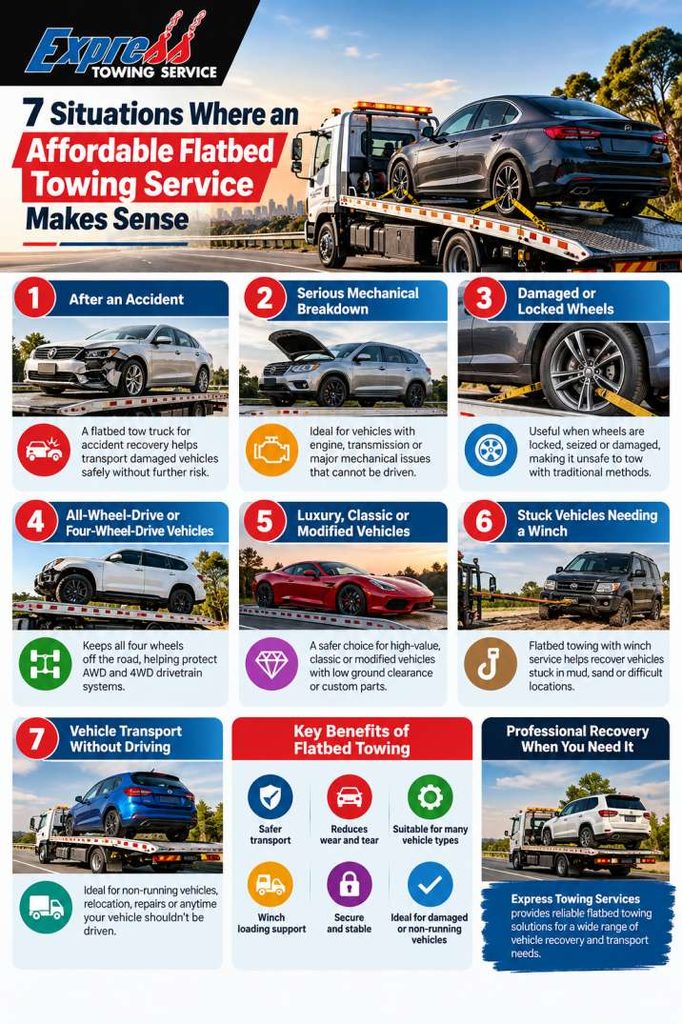
Not every vehicle problem requires a flatbed. However, the following situations are good examples of when this recovery method may be worth considering.
An accident can leave a vehicle with damage that is not immediately obvious. Even if the engine starts and the vehicle appears capable of moving, its wheels, suspension, steering or underbody components may have been affected.
Driving a damaged vehicle can make the situation worse. For example, a collision may cause:
In these circumstances, a flatbed tow truck for accident recovery can be a suitable option because the damaged vehicle can be carried on the platform rather than driven along the road.
Practical example: Imagine a vehicle involved in a side-impact collision. The engine is still running, but one wheel appears to sit at an unusual angle. Although the vehicle may move, driving it could place additional stress on damaged suspension or steering components.
A flatbed can help transport the vehicle without requiring that damaged wheel to roll along the road.
The operator should assess the vehicle’s condition and loading points before recovery. If there is significant structural damage, leaking fluids or another safety concern, specialised recovery procedures may be necessary.
Some mechanical problems make it unsafe or impossible to drive a vehicle.
A minor warning light does not always mean towing is necessary, but certain symptoms should not be ignored. Examples include:
A flatbed can be useful when the vehicle cannot be driven safely or when moving its wheels could cause further mechanical damage.
For instance, a vehicle with a failed transmission may not be suitable for conventional towing. Some transmissions require specific towing procedures because the internal components can be damaged if the driven wheels rotate while the engine is not operating.
The correct method depends on the vehicle manufacturer’s instructions and drivetrain design.
Before arranging towing, explain the symptoms clearly. Tell the operator whether the vehicle starts, whether the wheels turn freely and whether any warning lights or fluid leaks are present.
This information helps determine whether flatbed transport is appropriate and whether additional loading equipment is required.
A vehicle with damaged, seized or locked wheels can be difficult to move using ordinary towing equipment.
This problem may occur after:
Trying to drag a vehicle with locked wheels can damage its tyres, suspension, brakes or surrounding components.
A flatbed may provide a safer transport method, but loading still needs to be planned carefully. A vehicle with locked wheels may require skates, dollies, recovery equipment or another suitable technique to position it on the platform.
Practical example: Consider a vehicle that has been involved in a collision and can no longer roll because its front wheels are damaged. The operator may need to use additional recovery equipment rather than simply pulling the vehicle onto the flatbed.
The important point is that a flatbed does not eliminate the need for proper assessment. The operator must understand why the wheels are not moving and choose an appropriate loading method.
All-wheel-drive (AWD) and four-wheel-drive (4WD) vehicles may require specific towing procedures.
Their drivetrains can be more sensitive to differences in wheel rotation than some conventional two-wheel-drive vehicles. Depending on the design, towing with only one axle raised may cause unwanted movement through the transmission, transfer case or differential.
However, not all AWD and 4WD systems work in the same way. Some manufacturers permit particular towing methods under defined conditions, while others specify that all wheels must remain off the ground.
A flatbed is often a practical option because it allows the vehicle to be transported without its road wheels rotating.
Before arranging recovery, check the owner’s manual or manufacturer guidance where possible. If you are unsure about the drivetrain requirements, tell the towing operator the vehicle’s make, model and drivetrain type.
This is particularly important for modern vehicles with electronic all-wheel-drive systems, hybrid powertrains or specialised transmission arrangements.
The correct towing method should follow the vehicle manufacturer’s recommendations rather than relying on assumptions based on its appearance.
Some vehicles require additional care during loading and transport because of their design, value or specialised components.
Examples include:
A conventional towing method may not always provide suitable clearance or support for these vehicles.
A flatbed can be useful because it carries the vehicle on a platform. With the right loading equipment and procedures, it may reduce the risk of contact between vulnerable components and the road.
However, owners should not assume that every flatbed is automatically suitable for every vehicle.
Before recovery, explain any special requirements, such as:
The operator can then consider whether the available equipment is suitable.
For valuable or modified vehicles, clear communication before loading is especially important. It allows the recovery method to be planned around the vehicle rather than forcing the vehicle into an unsuitable loading arrangement.
A vehicle may become stuck in soft ground, mud, sand or another difficult surface. It may also be unable to move because of a mechanical failure or damage that prevents the wheels from turning.
In these situations, flatbed towing with winch service may be a suitable recovery approach.
A winch uses a powered cable or line to pull a vehicle towards the recovery platform. The operator must select an appropriate attachment point and control the pulling direction to avoid unnecessary stress on the vehicle.
Winch-assisted loading can be useful when:
Practical example: A car becomes stuck in soft ground after leaving a firm driveway surface. Its wheels spin, but it cannot gain traction. Depending on the ground conditions and vehicle position, a recovery operator may use a winch to bring it onto a flatbed.
There are important limitations. A winch is not a solution for every recovery situation. The vehicle’s position, weight, attachment points, ground stability and surrounding hazards must be considered.
If the vehicle is severely damaged or located in an unstable position, specialised recovery equipment or additional assistance may be required.
Flatbed towing is not limited to accident recovery and roadside breakdowns. It can also be useful when a vehicle needs to be moved but should not be driven.
Possible situations include:
This is where flatbed vehicle transport can offer practical advantages.
For example, a vehicle that has been sitting unused may have a flat battery, deteriorated tyres or an unknown mechanical condition. Rather than attempting to drive it without knowing whether it is roadworthy, arranging suitable transport may be the more sensible option.
The same applies to vehicles that have developed problems during maintenance or have components removed.
Before transport, confirm that the vehicle can be safely accessed and loaded. If it has no working brakes, steering or rolling wheels, the operator may need additional equipment.
The aim is to move the vehicle without creating further damage or exposing anyone to unnecessary risk.
The decision to use a flatbed should be based on the vehicle’s condition, not simply the type of towing equipment available.
An Affordable Flatbed Towing Service Makes Sense when it provides an appropriate way to transport a vehicle while reducing avoidable risks.
Consider these factors before choosing a recovery method:
| Vehicle condition | Why flatbed towing may be suitable |
|---|---|
| Accident damage | Reduces the need to drive or roll potentially damaged wheels |
| Transmission failure | Can prevent unwanted drivetrain movement during transport |
| Locked wheels | Allows recovery with suitable loading equipment |
| AWD or 4WD system | Keeps all road wheels off the ground |
| Low-clearance vehicle | Can support controlled loading with suitable equipment |
| Stuck vehicle | May allow winch-assisted loading |
| Non-running vehicle | Makes transport possible without driving it |
This table is a general guide, not a replacement for a vehicle-specific towing assessment. Some vehicles have special requirements, and the operator should confirm the appropriate method before recovery.
Choosing the right towing service involves more than confirming that a flatbed truck is available. The operator also needs accurate information about the vehicle and its location.
Explain whether the vehicle:
Avoid describing a vehicle as drivable simply because the engine starts. A vehicle may still be unsafe due to damage elsewhere.
Provide the make, model and approximate size of the vehicle. Mention whether it is AWD, 4WD, electric, hybrid, modified or fitted with unusual accessories.
This helps the operator consider the truck’s capacity and suitable loading arrangements.
Tell the operator if the vehicle is located in a narrow driveway, underground parking area, uneven ground or another restricted space.
Access conditions can affect the equipment and recovery approach required.
A professional recovery process should include appropriate positioning and restraint of the vehicle.
Ask how the vehicle will be loaded and secured, particularly if it has low ground clearance, damaged wheels or specialised components.
Where it is safe and practical, remove loose items that could move during loading and transport. Do not enter a damaged or unstable vehicle to retrieve belongings.
Also inform the operator about any unusual vehicle features that could affect loading.
Vehicle breakdowns and accidents do not always happen in convenient circumstances. A vehicle may become disabled in a car park, on a roadside or outside a property when the owner is not expecting a problem.
A 24 hour flatbed towing dispatch arrangement can help vehicle owners access recovery assistance when an unexpected situation occurs.
However, dispatch availability and actual recovery capability are not the same thing. The right truck and equipment must still be suitable for the vehicle and its location.
When requesting assistance, provide clear details about:
Accurate information helps the dispatch team understand the situation and identify the appropriate recovery requirements.
If the vehicle is in a dangerous position, prioritise personal safety and follow local emergency procedures. Do not stand in traffic or attempt to move a severely damaged vehicle yourself.
Even when flatbed towing is selected, poor preparation or incorrect assumptions can create unnecessary problems.
Flatbed trucks have different platform dimensions, load capacities and equipment. A large vehicle, modified car or heavy electric vehicle may require specific transport capability.
Always provide accurate vehicle details.
Different vehicles have different drivetrain, suspension and loading requirements. Following generic towing advice without checking the manufacturer’s guidance can lead to damage.
If the vehicle has steering, brake, suspension or wheel damage, attempting to drive it onto the platform may make the problem worse.
The operator should decide whether winching or another loading method is appropriate.
A lowered vehicle may scrape its bumper, exhaust or underbody during loading if the approach angle is unsuitable.
Mention modifications and clearance limitations before recovery begins.
Electric and hybrid vehicles may have specific handling and recovery instructions, particularly after a collision or battery-related incident.
Tell the operator the vehicle type and disclose any visible battery damage, warning messages, smoke or unusual heat. Do not touch damaged high-voltage components.
A few practical steps can make the recovery process clearer and more organised.
These steps help the recovery operator plan the job more effectively and reduce the chance of avoidable complications.
Choosing a towing provider means trusting someone to handle a vehicle that may already be damaged, disabled or difficult to move.
Express Towing Services focuses on helping vehicle owners understand their recovery requirements and arrange suitable towing assistance. The right approach depends on the vehicle, the reason it cannot be driven and the conditions at the recovery location.
Whether a vehicle has been involved in an accident, developed a mechanical fault or needs transport without being driven, providing accurate information helps determine the appropriate recovery method.
For owners considering an affordable flatbed towing service, the priority should be a suitable vehicle transport solution rather than choosing an option based on price alone.
A responsible recovery process considers vehicle compatibility, loading safety, securement and the manufacturer’s towing requirements. These details matter because the goal is not simply to move a vehicle, but to transport it without creating unnecessary additional damage.
Flatbed towing can be a practical solution when a vehicle is damaged, mechanically disabled, difficult to move or unsuitable for conventional towing. It is particularly useful for accident recovery, locked wheels, certain AWD and 4WD vehicles, modified cars and non-running vehicles.
The key is to choose a recovery method that suits the vehicle rather than assuming every breakdown requires the same approach. Proper assessment, suitable equipment, careful loading and secure transport all contribute to a responsible recovery process.
An affordable flatbed towing service should offer more than a way to move a vehicle. It should provide an appropriate transport solution that considers the vehicle’s condition and recovery requirements. Express Towing Services aims to help vehicle owners make informed decisions when arranging towing assistance, with vehicle suitability and safe handling remaining central to the process.
Flatbed towing can be a suitable option when a vehicle should not have its wheels rolling on the road. This is particularly relevant for accident-damaged vehicles, certain AWD models, vehicles with transmission problems and cars with damaged wheels.
However, it is not automatically safer in every situation. The correct towing method depends on the vehicle’s design, condition and manufacturer’s instructions. Proper loading and securement are essential regardless of the equipment used.
Yes. A flatbed can transport many vehicles that cannot start or move under their own power.
The loading method depends on the condition of the vehicle. If the wheels roll freely, the operator may be able to use a suitable loading approach. If the wheels are locked or the vehicle cannot be moved, winching equipment, skates or other recovery tools may be needed.
Always explain the vehicle’s condition before arranging recovery.
Flatbed towing is often a practical option for accident-damaged vehicles because it avoids the need to drive the vehicle or allow potentially damaged wheels to roll along the road.
However, significant structural damage, fluid leaks, damaged battery systems or unstable vehicle components may require specialised recovery procedures. The operator should assess the situation and select equipment that is appropriate for the damage.
Yes. A flatbed can be suitable for many AWD and 4WD vehicles because all four wheels can remain off the ground during transport.
This can help avoid drivetrain damage that may occur if a vehicle is towed incorrectly. Nevertheless, towing requirements vary between manufacturers and models. Always check the owner’s manual or manufacturer guidance and inform the operator about the drivetrain.
Provide the vehicle’s make, model, approximate size and location. Explain whether it starts, whether the wheels roll freely and whether it has accident damage, mechanical faults or visible leaks.
You should also mention modifications, low ground clearance, AWD or 4WD systems and any access restrictions.
Accurate details help the operator assess the recovery requirements and determine whether the available flatbed equipment is suitable.


