
The engine coughs once. Then it coughs again. The power steering stiffens, and your car rolls to a silent stop on the shoulder. You glance at the fuel gauge and feel your stomach drop.
Running out of gas happens to far more drivers than you might think. It happens to busy parents, long-haul commuters and careful drivers who trusted a gauge that read a little too kindly. A 24/7 emergency fuel delivery service for vehicles turns that moment from a crisis into a short delay.
This guide explains how a Fuel Delivery Service Gets You Moving Again, what happens to your car when the tank runs dry, and what to do while you wait. It also shows you how an on-demand vehicle fuel delivery service compares with a tow, so you can make the right call quickly.
Most empty-tank calls do not come from careless drivers. They come from ordinary situations that stack up at the wrong moment.
Understanding the mechanics helps you avoid making things worse.
Your electric fuel pump sits inside the tank. It uses the surrounding fuel to stay cool. When the tank empties, the pump runs hot and dry. It can also pull up sediment from the bottom of the tank. One empty-tank event rarely ruins a pump, but repeated ones shorten its life.
Diesel engines need more care. When a diesel runs dry, air enters the fuel lines. Air in a diesel system stops the engine from restarting, even after you add fuel. Many diesels need the fuel system primed or bled before they fire up again. A trained technician knows how to handle this step.
| Vehicle Type | Main Risk After Running Dry | What the Technician Does |
|---|---|---|
| Gasoline car | Fuel pump strain, sediment pickup | Adds fuel, primes the system with key cycles, restarts carefully |
| Diesel car or truck | Air trapped in fuel lines | Adds diesel, primes or bleeds the system, then restarts |
| Hybrid | Engine cannot recharge battery | Adds fuel and checks that the system restarts normally |
| Electric vehicle | No charge to move | Arranges a flatbed tow to a charging point, since fuel won’t help |
People picture a complicated process. In reality, a 24/7 emergency fuel delivery service for vehicles follows a simple, practised routine.
The dispatcher asks for your location, your vehicle type and, most importantly, the fuel type. Regular gas, premium or diesel all matter. Our team at Express Towing Services always confirms fuel type twice, because the wrong fuel causes far bigger problems than an empty tank.
The technician carries fuel in approved, sealed containers designed for safe transport. They park behind your vehicle with warning lights on to protect you from passing traffic.
The technician adds enough fuel to safely reach the nearest station. For gasoline cars, they often turn the key to the “on” position a few times before starting. This lets the pump push fuel through the lines first. For diesels, they prime or bleed the system as needed.
A good technician waits until the engine runs smoothly. They also watch for warning lights. If the car still won’t start, the problem may be more than fuel, and they can arrange a tow on the spot.
Not every stalled car needs a tow truck. Here is how to tell the difference.
Picture a common case. A driver calls in saying they ran out of gas on a back road. The technician adds fuel, but the engine only clicks. The real issue turns out to be a dead battery that drained while the driver kept trying to restart. One visit sorts out both problems, because the crew came prepared for more than fuel.
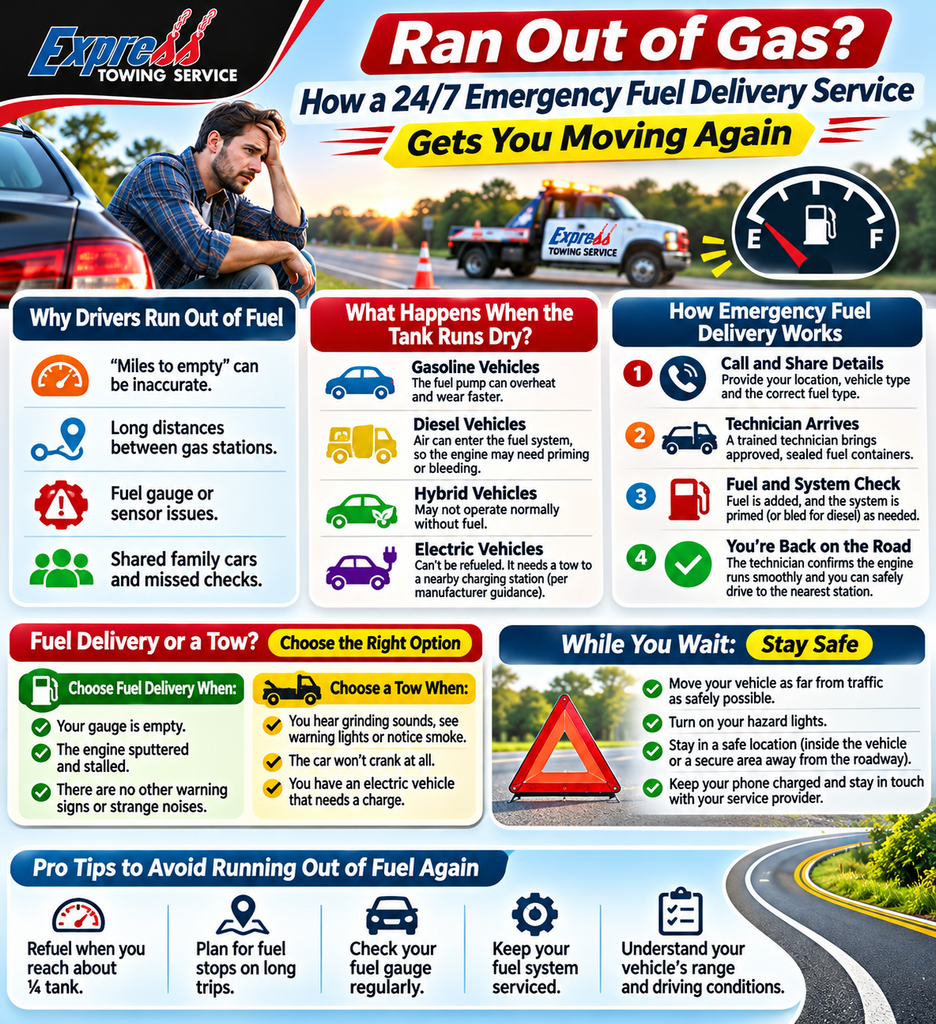
The wait matters as much as the fix. Follow these steps from the moment your car stops.
Our technicians at Express Towing Services see the same patterns again and again. These habits keep drivers out of trouble.
Running out of gas feels stressful, but you have clear options. Get safe, confirm your fuel type and call for help instead of walking the highway. Understanding how a Fuel Delivery Service Gets You Moving Again helps you stay calm and make the right choice between fuel and a tow.
Express Towing Services provides a 24/7 emergency fuel delivery service for vehicles, with trained technicians, approved containers and careful restarts for gasoline and diesel engines. When the gauge hits empty, our on-demand vehicle fuel delivery service gets you back on the road with minimal fuss.
A 24/7 emergency fuel delivery service for vehicles usually adds enough fuel to get you safely to the nearest gas station, not a full tank. The goal is to get you moving again, not to replace a normal fill-up. Our technicians judge the amount based on your location and vehicle. Once you reach the station, fill the tank fully so the pump stays cool and the engine runs smoothly.
One empty-tank event rarely causes lasting damage, but it does put strain on your fuel pump. The pump relies on surrounding fuel to stay cool, so it runs hot when the tank goes dry. It can also draw sediment from the bottom of the tank. Repeated empty-tank events shorten pump life. If your car runs rough after refuelling, have a mechanic check the fuel system soon.
Avoid cranking the engine over and over. When a diesel runs dry, air enters the fuel lines and stops the engine from restarting, even after you add fuel. Repeated cranking drains the battery and strains the starter. Tell the dispatcher that you drive a diesel. A trained technician adds the right fuel and primes or bleeds the system, which helps the engine restart safely without extra damage.
It depends on the cause. If your car stalled gently with the gauge on empty, an on-demand vehicle fuel delivery service usually solves the problem without a tow. If you hear grinding, see smoke, or the dashboard shows oil or temperature warnings, you likely face a mechanical fault. In that case, a tow makes more sense. Our dispatch team asks a few questions to help you choose correctly.
Hybrids take regular fuel, so a technician can refuel them like any gas car and check that the system restarts properly. Electric vehicles are different. They run on battery charge, so fuel cannot help. For a stranded EV, the safest option is a flatbed tow to a charging point. A flatbed protects the electric drivetrain, which can suffer damage if the wheels turn during towing.


