
Your car dies on the highway shoulder. You switch on the hazard lights and grab your phone. Then the real worry kicks in: who pays for the tow?
Drivers ask us this all the time at Express Towing Services. So does car insurance cover flatbed towing? Often it does. But the answer depends on your policy, what went wrong, and the steps you take in the first hour.
This guide explains how coverage works, where drivers lose money, and how an affordable flatbed towing service fits into your insurance claim. You will know exactly what to check before you ever need a tow.
When you call our 24 hour flatbed towing dispatch, you are often stressed and short on time. Knowing your coverage ahead of time takes a lot of that pressure away.
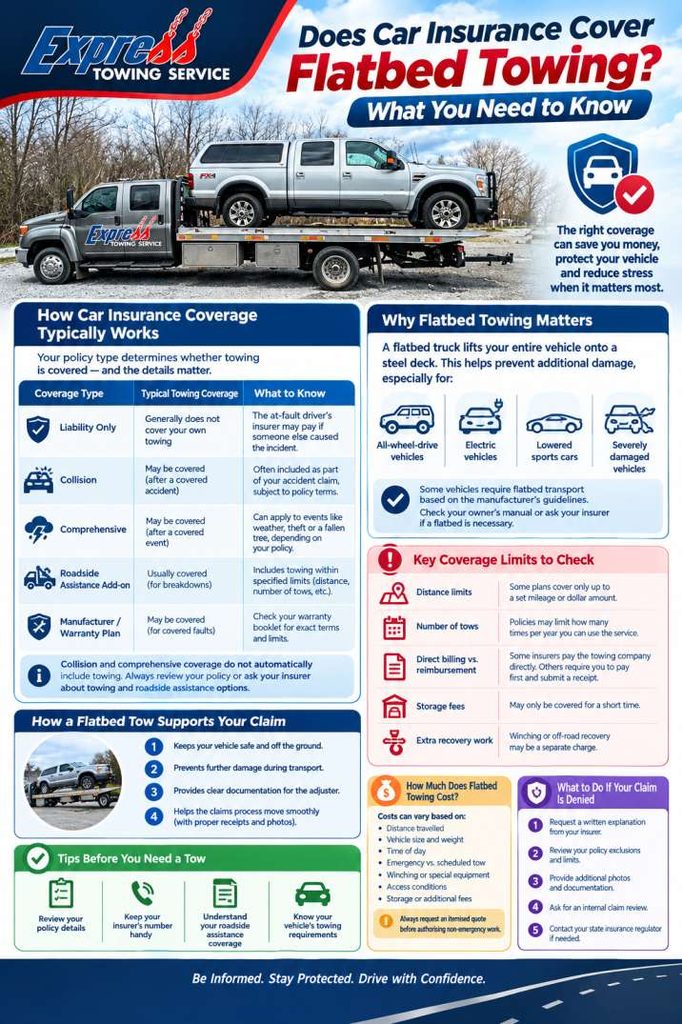
A flatbed truck lifts your entire vehicle onto a flat steel deck. No wheels touch the road. A wheel-lift truck works differently. It raises one end and drags the other end on its tyres.
Many modern cars need a flatbed. All-wheel-drive cars, electric vehicles, lowered sports cars and badly damaged cars can suffer harm on a wheel-lift. Drivers then wonder whether their insurer will pay for the safer option or only the basic one.
The good news is simple. Most insurers care about why you needed a tow, not the type of truck. If the flatbed protects your car from extra damage, it usually makes sense to the insurer too.
Your policy type decides most of the answer. Here is how common coverage types usually treat towing:
| Coverage Type | Does It Usually Cover Your Tow? | What to Know |
|---|---|---|
| Liability only | Usually no (for your own car) | The at-fault driver’s insurer may pay if someone else caused the crash |
| Collision | Often yes, after a covered accident | The tow becomes part of your accident claim |
| Comprehensive | Often yes, after a covered event | Think flood damage, a fallen tree, or a recovered stolen car |
| Roadside assistance add-on | Usually yes, for breakdowns | Limits apply on distance and number of tows |
| Manufacturer or warranty roadside plan | Often yes, for covered faults | Check your warranty booklet and its terms |
Every insurer writes its own rules. Treat this table as a starting point, then read your own policy.
A breakdown and an accident follow different paths. A dead battery or blown engine falls under roadside assistance. A crash falls under collision coverage or the other driver’s liability coverage.
Many drivers carry collision coverage but skip the roadside add-on. They feel shocked when the insurer refuses to pay for a simple breakdown tow. Check both parts of your policy, not just one.
After a crash, the tow is not just a ride to the garage. It forms part of your claim record. The way your car gets moved can affect your payout.
A flatbed tow truck for accident recovery keeps the damaged car fully off the ground. Bent axles, broken suspension and leaking parts stay where they are. The repair shop and the insurance adjuster see the damage exactly as the crash left it.
Picture a common case. A driver’s sedan takes a hit on the rear corner, and the wheel sits at an odd angle. A wheel-lift tow could drag that wheel and cause fresh damage. The insurer might then question which damage came from the crash. A flatbed avoids that dispute completely.
Here is what usually happens after an accident tow:
Even when your policy covers towing, limits apply. These small details catch many drivers off guard.
Insurance covers emergencies. It rarely covers planned trips.
Say you buy a classic car from a seller across the state. You want it moved on a flatbed to keep it safe. That counts as planned vehicle transport, not an emergency. Your insurer will almost never pay for it.
The same rule applies when you move house, ship a non-running project car, or send a car to a body shop for cosmetic work. For these jobs, an affordable flatbed towing service gives you a safe, budget-friendly option without any insurance claim at all.
Follow these steps in order, and you protect both your car and your claim.
Our operators have loaded thousands of vehicles, from small hatchbacks to heavy pickups. These habits save drivers real money and stress.
So, does car insurance cover flatbed towing? In many cases, yes. Collision coverage often handles accident tows. Comprehensive coverage handles many non-crash events. A roadside add-on usually covers everyday breakdowns. Liability-only drivers usually need the other driver’s insurer to pay.
Take ten minutes today to read your policy. Check your distance limits, your tow allowance and how your insurer pays the bill.
When the moment comes, choose an affordable flatbed towing service that keeps your car safe and your paperwork clean. Express Towing Services provides clear itemised receipts, careful loading and 24 hour flatbed towing dispatch whenever your car lets you down. Our team even handles a flatbed tow truck for accident recovery with the care your insurance claim needs.
It usually depends on whether you carry roadside assistance. Collision and comprehensive coverage normally cover damage from crashes or events like floods, not mechanical failure. A roadside assistance add-on, or a manufacturer warranty plan, often covers breakdown tows within set limits. Check your policy for “towing and labour” wording. If you do not have it, an affordable flatbed towing service still gives you a safe, low-cost way home.
Most insurers focus on whether the tow was necessary, not the truck type. If your car is AWD, electric, lowered or badly damaged, a flatbed is the safe choice, and insurers usually accept that reasoning. Tell your insurer why the car needed a flatbed and keep an itemised receipt. A clear reason and solid paperwork help your claim. Some plans cap payouts, so you may pay any difference above that limit.
The at-fault driver’s liability insurance usually pays for your towing and repairs. However, that claim can take time while insurers decide fault. Many drivers use their own collision coverage first, and their insurer then recovers the cost from the other driver’s insurer. Either way, take photos, collect the other driver’s details and get a police report. A flatbed tow truck for accident recovery keeps the damage intact for the adjuster to review fairly.
Coverage for long distance flatbed towing depends on your policy’s mileage limit. Many roadside plans cover a tow only to the nearest qualified repair shop or up to a set distance. If you want your car taken further, you often pay for the extra miles. Ask your insurer about the limit before you book. Our dispatch team can explain the route and charges clearly, so you face no surprises when the car arrives.
Give the dispatcher your exact location, your car’s make and model, the drivetrain type and the car’s condition. Mention if the car rolls, has flat tyres or sits in a ditch. Ask whether they provide an itemised receipt for insurance and confirm the drop-off address. Our 24 hour flatbed towing dispatch team asks these questions upfront. This way the right truck arrives the first time, and your insurance paperwork stays complete and accurate.


