

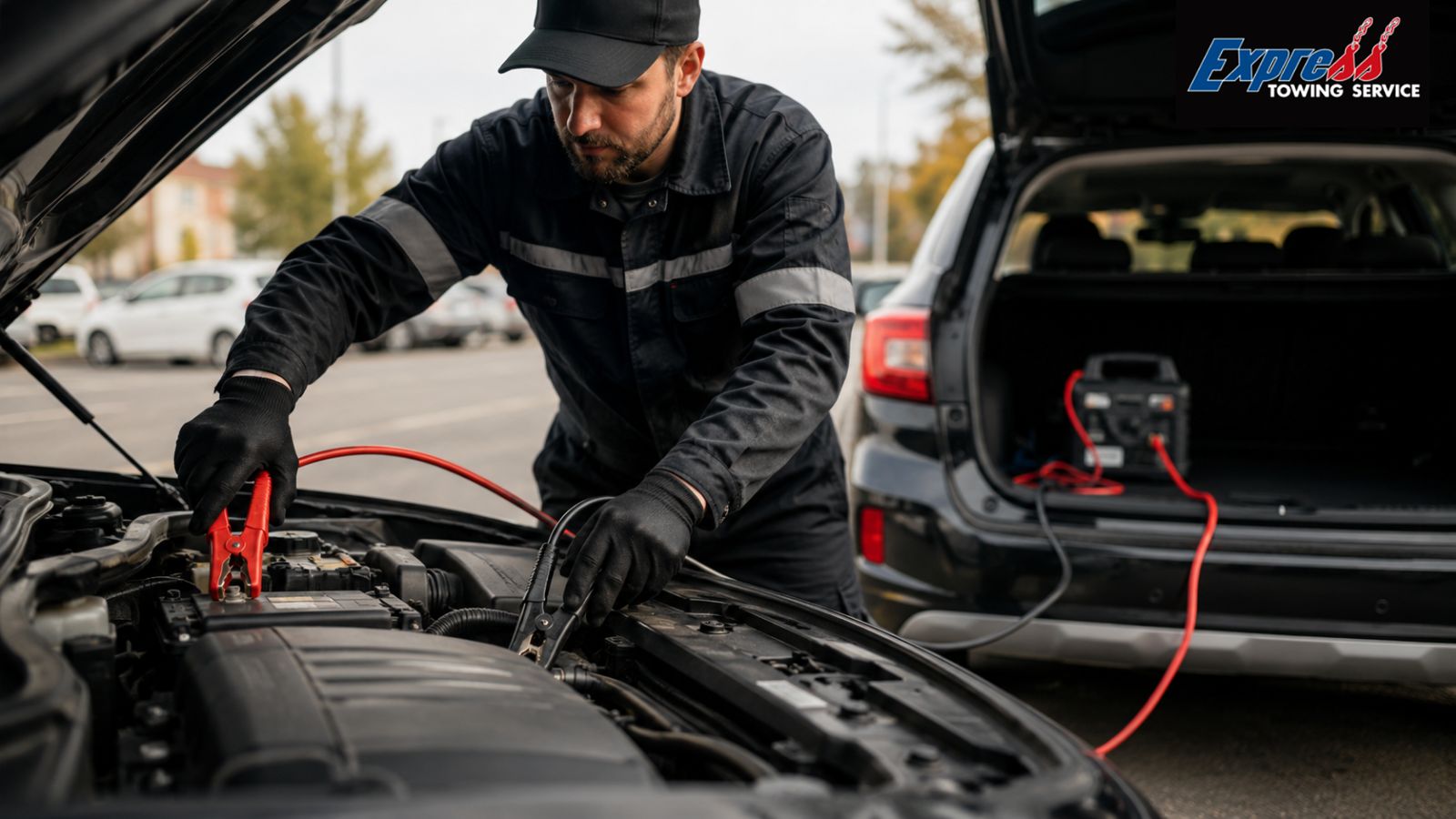
A dead car battery rarely happens at a convenient time. It may happen before work, outside a grocery store, in your driveway, or on a cold Canadian morning when your vehicle refuses to start. You turn the key or press the start button, hear a clicking sound—or nothing at all—and suddenly a routine trip becomes a roadside problem.
Knowing what to do next can save time and help you avoid unnecessary damage to your vehicle.
A professional battery boost service in Canada provider can safely assess the situation, perform a proper boost, and help determine whether the battery simply needs assistance or may be approaching the end of its useful life. This distinction matters because a successful jump start does not necessarily mean the battery is healthy.
For Canadian drivers, where freezing temperatures can significantly affect battery performance, having access to dependable roadside assistance can be particularly useful. This guide explains what causes battery failure, how a professional Battery Boost Service in Canada works, when a jump start is appropriate, and what you should do after your vehicle gets running again.
Many drivers assume that a battery will gradually show obvious signs of failure. Sometimes it does, but batteries can also fail unexpectedly.
A vehicle battery supplies the electrical power needed to operate the starter motor and various electrical systems. When the engine is running, the alternator generally replenishes the energy used during starting and powers the vehicle’s electrical equipment.
Several factors can reduce battery performance.
Leaving electrical equipment switched on is one of the simplest causes. Interior lights, headlights, accessories, or other electrical loads can drain a battery when the engine is off.
Cold temperatures are another major factor. Low temperatures can reduce a battery’s ability to deliver starting power while making the engine harder to crank. A battery that performs adequately in moderate weather may struggle during a particularly cold Canadian morning.
Battery age also matters. As a battery gets older, its ability to hold and deliver sufficient charge can decline.
Other potential causes include:
This is why repeatedly boosting a vehicle without identifying the underlying cause is not always the best solution.
A battery boost provides temporary electrical assistance to a vehicle with insufficient battery power to start the engine.
The basic principle is straightforward. A booster pack or another suitable power source provides enough electrical energy for the starter motor to crank the engine. Once the engine starts, the vehicle’s charging system can begin supplying electrical power.
However, a proper boost involves more than simply connecting cables.
The vehicle type, battery location, battery condition, terminal configuration, and manufacturer’s recommendations should all be considered. Modern vehicles can also contain sensitive electronic systems, making correct connection procedures important.
A professional technician can assess the vehicle before attempting the boost and use appropriate equipment for the situation.
Connecting booster cables incorrectly can cause electrical problems, sparks, or damage to components.
Professional technicians generally verify:
If a battery is visibly cracked, leaking, swollen, or otherwise damaged, attempting to boost it may be unsafe. In that situation, the problem requires a different response.
Not every dead battery requires professional assistance, but there are many situations where calling a qualified roadside provider is the safer and more practical choice.
For example, imagine leaving a shopping centre after dark and discovering that your vehicle will not start. You may not have booster cables, another vehicle may not be available, and trying to troubleshoot the problem in a busy parking lot may be inconvenient.
A professional service can bring appropriate equipment directly to the vehicle.
The same applies if:
The objective is not simply to make the engine start. It is to address the situation safely and determine what should happen next.
When a vehicle will not start, avoid immediately assuming that the battery is completely dead.
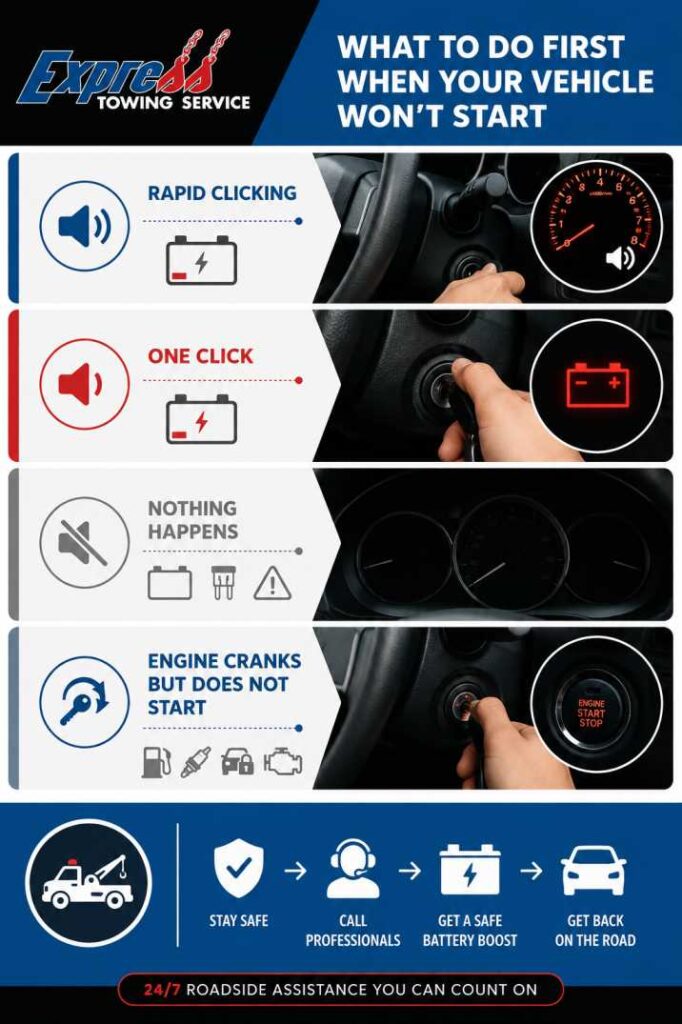
First, pay attention to what happens when you attempt to start the vehicle.
Rapid clicking commonly indicates that the starter is not receiving enough electrical power. A weak or discharged battery is one possible explanation.
A single click can also be associated with insufficient battery power, but it may have other causes. Starter-related problems and electrical issues can produce similar symptoms.
No lights, sounds, or dashboard activity may indicate a severely discharged battery, a connection issue, a blown fuse, an electrical fault, or another problem.
This is an important distinction.
If the starter turns the engine normally but the engine does not fire, the battery may not be the primary problem. Fuel delivery, ignition, immobilizer systems, sensors, or other mechanical and electrical issues could be involved.
This is one reason professional roadside assessment can be valuable. A battery boost is not a universal solution for every no-start condition.
A successful boost can get your vehicle moving, but it does not automatically prove that the battery is healthy.
Consider this common scenario.
A driver leaves an interior light on overnight. The battery becomes discharged. A technician performs a successful boost, and the vehicle starts normally.
That does not necessarily mean the battery needs replacement.
Now consider a different situation. The same vehicle needs a boost every few weeks, even though no lights have been left on. That repeated failure suggests there may be an underlying issue.
The battery itself could be deteriorating, or the vehicle’s charging system could require attention.
A battery boost and battery health check can therefore provide more useful information than simply getting the engine running.
Depending on the equipment and service provided, an assessment may help evaluate:
This distinction is particularly useful in winter. If a marginal battery barely starts the vehicle in mild weather, it may struggle significantly when temperatures drop.
A jump start is intended to provide temporary starting assistance. It does not recharge a completely failed battery into a healthy battery, nor does it repair a damaged battery.
There are several possible outcomes after a boost.
If a light was accidentally left on and the battery is otherwise healthy, the vehicle may operate normally after being started and sufficiently recharged.
An older battery may accept enough assistance to start the vehicle but continue to have difficulty starting the engine later.
If the alternator is not charging correctly, the battery may become discharged again after the boost.
An unexpected parasitic drain may continue consuming power while the vehicle is parked.
The key lesson is simple: a successful jump start is a starting point, not necessarily the final diagnosis.
Canadian weather presents unique challenges for vehicle batteries.
When temperatures fall, battery performance can decrease while the engine may require more effort to crank. Oil can also become more viscous in cold conditions, increasing resistance during starting.
This combination can place additional demand on the battery.
A battery that seems acceptable in warmer conditions may therefore reveal its weakness during winter.
Imagine a driver in Canada has a vehicle with an aging battery. Throughout autumn, the vehicle starts without noticeable problems. One particularly cold morning arrives, and the starter turns slowly before stopping.
The driver tries again and receives only clicking sounds.
In this situation, repeatedly turning the ignition may further discharge the battery. Calling a professional Battery Boost Service in Canada provider can provide a safer way to get the vehicle assessed and started.
The experience also provides a useful warning: if the battery is old or repeatedly struggles in cold weather, it may be worth having it tested before the next severe temperature drop.
A professional roadside battery boost service typically begins with assessing the vehicle and the circumstances surrounding the no-start condition.
The technician may ask questions such as:
These details help distinguish a simple discharge from a potentially larger problem.
After checking the vehicle, the technician can determine whether a boost appears appropriate and use suitable equipment.
Once the engine starts, the technician may recommend additional battery or charging-system checks if the circumstances indicate that the problem could recur.
People often think of roadside service as something used only during major breakdowns.
In reality, small electrical problems can leave a vehicle unusable just as effectively as mechanical failures.
A dead battery can prevent:
A professional roadside response can reduce the amount of time a driver spends troubleshooting an unfamiliar problem in an inconvenient location.
The safety aspect is also important. A driver stranded near traffic, in poor visibility, or in severe weather may be better served by requesting professional assistance rather than attempting an unfamiliar procedure.
A vehicle that cranks normally but does not start may have an issue unrelated to the battery.
Do not repeatedly attempt battery boosts without considering other possible causes.
Frayed, damaged, or poorly maintained cables can create unnecessary risks.
If your equipment is visibly damaged, replacing it is preferable to relying on it during an emergency.
A swollen, cracked, or leaking battery should not simply be treated as a routine boost situation.
Visible damage can indicate that the battery requires further attention.
If your vehicle needs frequent boosts, investigate why.
Repeatedly restoring enough power to start the engine does not solve an underlying battery, alternator, or electrical-drain problem.
Driving after a boost may allow the charging system to replenish some battery energy, but it is not a guaranteed solution for a weak or damaged battery.
If the vehicle repeatedly struggles to start, professional testing is more useful than relying on longer drives.
You cannot eliminate battery failure completely, but sensible maintenance can reduce the likelihood of being stranded.
Look for visible corrosion, loose connections, physical damage, or other abnormalities.
A noticeably slower engine crank can be an early warning sign, especially if it occurs repeatedly.
If winter is approaching and the battery is already showing signs of weakness, have it assessed rather than waiting for the first major cold snap.
When the engine is off, switch off lights and accessories that are not required.
If a battery repeatedly loses power despite normal use, do not assume the battery itself is always responsible. The vehicle may have an electrical drain or charging-system issue.
One of the most useful lessons from roadside situations is that the circumstances surrounding battery failure matter.
A battery that dies once after a driver accidentally leaves the headlights on is different from a battery that repeatedly fails without an obvious reason.
Similarly, a vehicle that struggles only during severe cold weather may require a different approach from one that has increasingly slow starts throughout the year.
When requesting Battery Boost Service in Canada, be prepared to tell the technician what happened before the vehicle stopped starting.
Useful information includes:
These details can make the roadside assessment more efficient.
If your car battery appears dead, use this practical sequence:
This approach helps prevent a temporary starting problem from becoming a recurring inconvenience.
DIY jump-starting is possible when a driver has suitable equipment and understands the correct procedure. However, not everyone has the equipment, confidence, or appropriate conditions to do it safely.
Professional assistance can be particularly useful when the vehicle is in an unfamiliar location, the weather is severe, the battery is difficult to access, or the reason for the failure is unclear.
For Canadian drivers, having access to a dependable professional battery boost service in Canada provider can provide an important roadside option when a vehicle suddenly refuses to start.
A dead battery can turn an ordinary day into an unexpected roadside problem, but knowing how to respond makes the situation much easier to manage.
A Battery Boost Service in Canada provider can help restore starting power when a battery is discharged and, where appropriate, help identify whether further battery or charging-system attention may be necessary.
The most important point is not to confuse a successful boost with a complete diagnosis. If your vehicle repeatedly requires a boost, starts slowly, or struggles whenever temperatures fall, investigate the underlying cause.
For drivers who need roadside assistance, Express Towing Services can be a practical option to consider when a vehicle will not start and professional roadside support is required. The right response is not simply getting the engine running—it is getting you moving safely while understanding what may have caused the problem in the first place.
Common signs include clicking when attempting to start the vehicle, dim interior or dashboard lights, slow engine cranking, or no electrical response at all. However, these symptoms can have multiple causes. If the engine cranks normally but does not start, a battery boost may not solve the problem. A professional assessment can help determine whether insufficient battery power is actually responsible.
It can be safe when the correct equipment and procedure are used, but mistakes can cause sparks, electrical damage, or injury. The vehicle’s battery should also be inspected for visible damage before attempting a boost. Drivers who are uncertain about cable connections, battery location, vehicle-specific procedures, or battery condition should consider professional roadside assistance instead.
A recurring dead battery can have several explanations. The battery may be old or unable to hold a sufficient charge, the alternator may not be charging correctly, or an electrical component may be draining power while the vehicle is parked. If the same vehicle repeatedly needs a boost, arranging a battery and charging-system assessment is more useful than repeatedly jump-starting it.
Yes. Cold temperatures can reduce the battery’s ability to deliver starting power while increasing the effort required to crank the engine. A battery that is already aging or weakened may therefore fail during a cold spell even if it appeared to work normally beforehand. Winter battery testing and timely maintenance can help identify marginal batteries before they become a roadside problem.
Not necessarily. If the battery was discharged because lights were accidentally left on and the battery remains healthy, replacement may not be required. However, repeated failures, slow starting, advanced battery age, physical damage, or poor test results may indicate that replacement or additional diagnosis is appropriate. A professional should assess the circumstances rather than recommending replacement solely because a boost was required once.


