
A vehicle accident can turn an ordinary drive into a confusing and stressful situation within seconds. Once everyone is safe, drivers often have a long list of questions: Can I drive the vehicle? Should I call a tow truck? Where will the damaged car go? Will insurance pay for towing? What happens if the crash occurs on a highway?
These questions matter because a damaged vehicle can present risks that are not always obvious at the scene. A car may look driveable while having damage to its steering, suspension, wheels, brakes, cooling system or structure.
This is where an emergency accident towing service becomes important. Professional towing is not simply about moving a vehicle from one location to another. After a collision, the towing process needs to account for the vehicle’s condition, location, traffic hazards, recovery method and eventual destination.
Understanding what happens after an accident can help you make calmer, safer decisions when the situation is already stressful.
Before arranging towing, deal with the immediate safety issues.
If the accident has caused injuries or created an immediate danger, contact emergency services first. Move to a safe location when it is possible and safe to do so.
Once the immediate situation is under control, consider these steps:
One important mistake is treating the ability to start the engine as proof that the vehicle is safe to drive.
After a collision, that assumption can be dangerous.
Not every minor collision requires a tow.
However, towing should be seriously considered when there is visible or suspected damage that could affect safe operation.
Examples include:
Even when the damage appears cosmetic, it is sensible to follow the advice of qualified professionals and your insurer before deciding to drive away.
When a tow truck arrives after an accident, the operator will generally assess the vehicle and surrounding conditions before deciding how it should be moved.
This initial assessment is important.
The operator may consider:
The towing method depends on the vehicle and the extent of damage.
A standard wheel-lift arrangement may be suitable for some situations, while a flatbed may be more appropriate for heavily damaged vehicles, certain all-wheel-drive vehicles or vehicles that cannot safely roll.
The objective is to move the vehicle without creating additional damage.
A highway accident creates an additional safety concern because passing traffic may be travelling at high speed.
If your vehicle is disabled on a highway, avoid attempting complicated repairs in an exposed traffic environment.
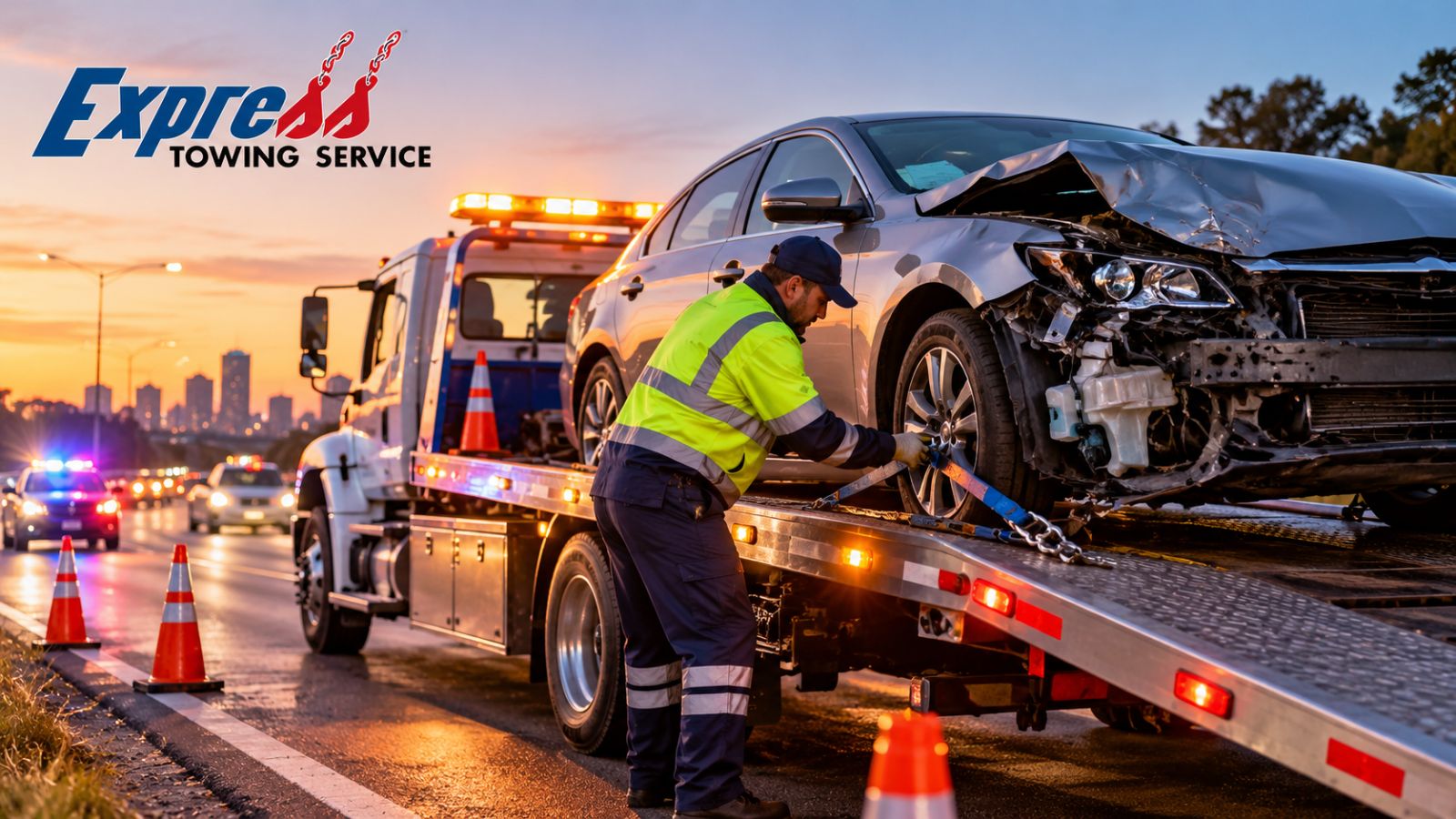
A tow truck for accident on highway recovery may need to approach the vehicle from a safe position and work around traffic, shoulders, barriers and other roadside hazards.
The towing operator may need to consider:
Drivers should follow instructions from police, highway authorities and roadside professionals rather than attempting to reposition a badly damaged vehicle themselves.
A damaged car sitting close to moving traffic can become a secondary hazard.
For that reason, professional recovery is about more than attaching a vehicle to a truck. The operator needs to establish a safe working area and select equipment appropriate to the vehicle’s condition.
This is one reason accident towing should not be treated exactly like ordinary vehicle transport.
Once the towing method has been determined, the operator will secure the vehicle for transportation.
Depending on the situation, the process may involve:
The tow operator first determines how the vehicle can be safely accessed and loaded.
If the wheels can roll normally, loading may be relatively straightforward.
If the wheels are locked, damaged or positioned incorrectly, additional recovery equipment may be necessary.
The appropriate lifting or loading equipment is positioned according to the vehicle’s condition.
Extra care may be required where:
Before transportation, the vehicle must be properly secured.
This is particularly important after an accident because damaged components may not behave like they normally would.
The destination depends on the circumstances.
It could be:
The driver should confirm the destination before the vehicle leaves whenever circumstances allow.
The vehicle recovery after accident does not necessarily end when the tow truck reaches its destination.
There can be several steps afterward.
The vehicle may undergo an inspection to determine:
The insurer may then assess the claim according to the driver’s policy and the circumstances of the collision.
Depending on the situation, the vehicle could ultimately be repaired or classified as a total loss under the applicable insurance process.
This is why drivers should keep records of the towing arrangements, destination, photographs and relevant documentation.
The phrase insurance approved towing Canada can sound straightforward, but insurance arrangements can differ depending on the province, policy and insurer.
Not every towing provider is automatically approved under every insurance policy.
Some insurers may have preferred or contracted towing providers. Others may allow customers to arrange towing independently, subject to policy terms, limits and documentation requirements.
Before assuming that towing will be reimbursed, check:
If the police or another authority has already arranged towing, ask where the vehicle has been taken and how you can obtain information about the tow and storage arrangements.
Unexpected storage charges can become an issue when a damaged vehicle remains at a facility for longer than necessary.
If you know your insurer’s preferred process, you may be able to reduce confusion about where the vehicle should go next.
The exact rules vary, so policy-specific information should always come from your insurer or policy documents.
Searching for affordable accident tow and recovery is understandable after an unexpected crash.
However, the cheapest advertised towing rate does not necessarily represent the lowest overall cost.
A towing bill can potentially involve more than the basic transportation charge.
Depending on the circumstances, costs may relate to:
Before authorising non-emergency additional work, ask what is included in the quoted price.
If your insurance is involved, also ask whether the insurer needs to authorise the destination or towing provider.
A clear price discussion at the beginning can prevent unpleasant surprises later.
When requesting an emergency accident towing service, provide as much accurate information as possible.
Useful details include:
If you are unsure about the damage, simply explain what you can see.
For example:
“The front driver’s-side wheel is damaged and the vehicle cannot move safely.”
That is more useful to the towing operator than simply saying the car has “some damage.”
A vehicle can appear mostly intact while suffering damage underneath.
Steering, suspension and alignment problems may not be obvious from outside.
If there is doubt about roadworthiness, professional assessment is safer than taking a chance.
Some drivers immediately choose the nearest repair shop.
That may be practical, but it is worth checking whether your insurer has specific requirements or preferred facilities.
When it is safe, photographs can help document the condition of the vehicle and accident scene.
Take images from several angles rather than only photographing the most obvious damage.
After a stressful accident, it is easy to assume the vehicle will simply go to a nearby repair shop.
Confirm the destination and keep the towing documentation.
If a damaged vehicle is placed in storage, ask about the process for retrieving or transferring it.
Storage costs can become significant if the vehicle remains there unnecessarily.
A few practical habits can make the process easier.
You do not want to search through paperwork while standing beside a damaged vehicle.
Keep relevant insurance and roadside assistance information available on your phone or in the vehicle, where appropriate.
If your insurer provides a specific claims or roadside assistance number, save it before you need it.
When safe, document the vehicle’s condition before loading.
Additional photographs after recovery can also help maintain a record of the vehicle’s condition.
If it is safe and permitted, remove valuable personal belongings from the vehicle before it is transported.
Do not enter a badly damaged vehicle simply to retrieve something.
It is reasonable to ask:
Clear answers are part of good roadside service.
This situation is common.
A vehicle may refuse to move because of a damaged tyre, bent suspension, locked wheel or electronic fault even when the bodywork does not look badly damaged.
Do not assume that “minor-looking” means “safe to tow with any method.”
The towing operator should assess the vehicle and use equipment suitable for its condition.
For example, dragging a vehicle with a damaged wheel can potentially cause further damage. Appropriate loading equipment can avoid unnecessary stress on the affected components.
After an accident, an insurer may determine that repairing the vehicle is not economically appropriate under the applicable policy and assessment process.
If that happens, the process may involve:
The exact process varies between insurers, policies and jurisdictions.
The towing company generally handles vehicle transportation and recovery; the insurer and relevant claims professionals handle coverage and settlement decisions.
Understanding that distinction helps avoid confusion about who is responsible for each part of the process.
When comparing towing companies, do not look only at the headline price.
Consider whether the provider can handle the type of recovery you actually need.
Ask about:
A company that regularly handles collision recovery may be better equipped to deal with vehicles that cannot simply be driven or lifted conventionally.
For local drivers, Express Towing Services can be considered when arranging accident-related towing, but homeowners and drivers should still confirm availability, pricing, destination and insurance requirements for their particular situation.
When you are under pressure, a checklist can help.
A serious collision creates enough uncertainty without adding confusion about what happens to the vehicle afterward.
The key is to treat towing as part of the wider accident-recovery process. First protect people and the accident scene. Then determine whether the vehicle is safe to move, contact the appropriate insurer or roadside provider, and arrange the correct recovery equipment.
A professional emergency accident towing service can help remove a damaged vehicle safely from a dangerous location, particularly when the crash occurs on a busy highway or the vehicle has suffered wheel, steering or suspension damage.
The vehicle recovery after accident should then continue with clear documentation, an appropriate destination and communication with the insurer or repair facility.
Most importantly, do not make decisions based solely on appearance or price. A damaged vehicle needs the right recovery method, and insurance arrangements should be confirmed rather than assumed. With a calm, informed approach, the towing stage can be handled much more smoothly—even after a stressful crash.
You should consider an emergency accident towing service when the vehicle cannot be safely driven, has significant mechanical or structural damage, is blocking a hazardous location, or has suffered damage that could affect steering, braking, wheels or suspension.
If you are uncertain, explain the visible damage to the towing operator and ask what recovery method is appropriate. After a serious collision, safety should take priority over trying to drive the vehicle home.
Sometimes, but the fact that the engine starts does not establish that the vehicle is safe.
Check for warning lights, fluid leaks, damaged wheels, steering problems, unusual noises and visible suspension or body damage. If there is any concern about roadworthiness, seek professional advice rather than assuming the vehicle is safe because it moves.
It depends on the insurance policy, province, circumstances and insurer’s claims process.
Some policies provide towing or roadside assistance coverage, while others may have limits, preferred providers or specific requirements. Contact your insurer as soon as practical and keep all towing receipts and documentation.
The phrase insurance approved towing Canada should therefore not be treated as a guarantee that every towing company or every tow will be covered.
The vehicle may be taken to a repair facility, collision centre, dealership, insurer-approved location or another agreed destination.
Afterward, the vehicle may be inspected for visible and hidden damage. The insurer may assess the repair costs and determine the next stage of the claim according to the applicable policy.
Always confirm the destination before the vehicle leaves when circumstances permit.
Not necessarily.
The final cost can depend on recovery complexity, distance, equipment, after-hours work and storage. A very low initial rate may not include every service required.
Instead of comparing only the starting price, ask what the quote includes and whether additional charges could apply. If insurance is involved, also check whether the provider and destination meet your insurer’s requirements.


