
The dashboard lights flicker. The engine sputters, loses power and goes quiet. You coast to the shoulder, switch on your hazards and sit there wondering what happens next.
For most drivers, Roadside Breakdown Towing feels like a mystery. Who do you call? What do they need to know? Where does your car go, and how do you get home? Not knowing makes a stressful moment feel even worse.
This guide walks you through the full process of roadside breakdown towing for cars, from the moment you pick up the phone to the moment your car arrives at the shop. We share what our operators see every day, so you know exactly what to expect.
You’ll also learn when a breakdown calls for accident breakdown towing and recovery, and when a simple fix on the spot can save you a tow altogether.
Sometimes a dead battery is the only problem, and a car breakdown towing and jump-start service can sort it out right at the roadside. Knowing the difference saves time, money and stress.
Breakdowns rarely come out of nowhere. Most start as small problems that build quietly until something gives out.
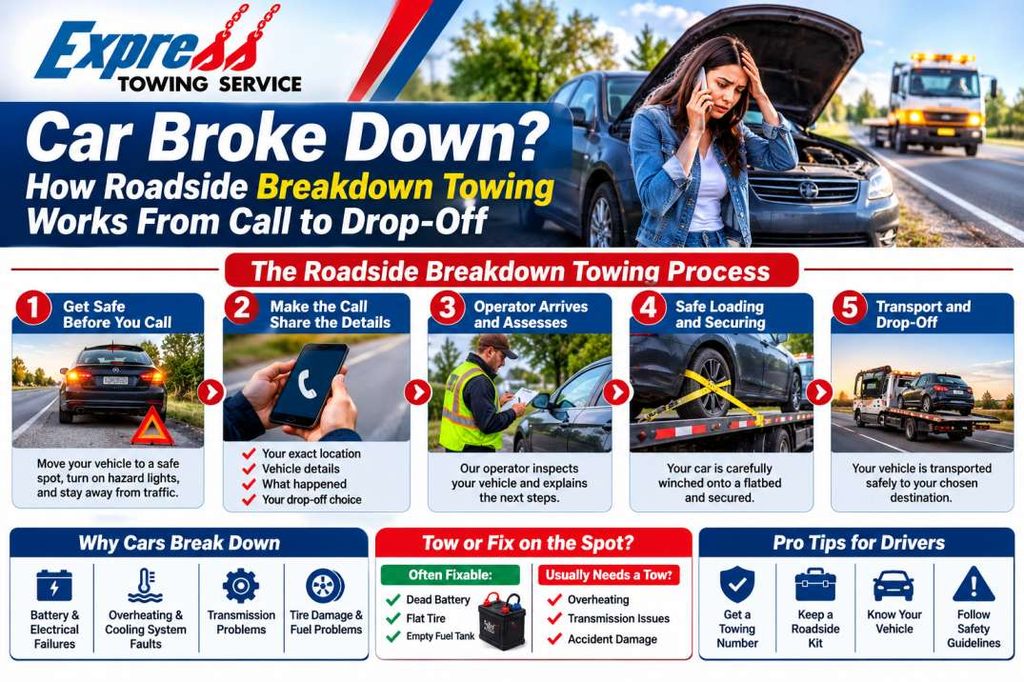
Understanding each stage of roadside breakdown towing for cars takes the guesswork out of a stressful situation. Here is what happens from start to finish.
Safety always comes first. Move your car as far off the road as you can and switch on your hazard lights. If traffic passes close by, stay buckled inside the car. If you must get out, use the side away from traffic.
The dispatcher needs clear information to send the right truck. Be ready to share:
When the truck arrives, a good operator parks safely and checks the scene first. They look at the car’s position, its condition and any hazards nearby. They confirm your details and the drop-off location. A professional operator also explains the plan before they start, so nothing comes as a surprise.
Most modern cars travel best on a flatbed, which carries the whole vehicle off the ground. The operator winches the car slowly onto the deck and secures it with wheel straps or chains on proper tie-down points. They avoid bumper covers and fragile parts. A careful load protects your car’s suspension, wheels and drivetrain during the trip.
During transport, the operator drives smoothly and checks the straps as needed. At the drop-off point, they unload the car carefully and confirm its condition with you or the shop. Ask for a clear receipt that shows the pick-up location, the drop-off address and the services provided. This record helps with insurance claims and repair records.
Not every breakdown needs a tow truck. Many problems can be solved right where your car stopped.
| Problem | Fix on the Spot? | Usual Solution |
|---|---|---|
| Dead or weak battery | Often yes | A jump-start and battery check |
| Empty fuel tank | Usually yes | Emergency fuel delivery |
| Simple flat tire with a usable spare | Often yes | A roadside tire change |
| Overheating with a leak or broken hose | Usually no | A tow to a mechanic |
| Transmission or drivetrain failure | No | A flatbed tow |
| Collision damage | No | Accident towing and recovery |
A provider that offers a breakdown towing and fuel delivery service under one roof can adapt on the spot. If fuel or a boost doesn’t solve the problem, the same team can load the car and tow it right away, without a second call.
A breakdown caused by a crash needs extra care. Damaged suspension, leaking fluids and bent wheels mean the car must never be dragged or forced. Accident breakdown towing and recovery focuses on moving the car without adding new damage, so your insurer sees the crash damage exactly as it happened.
Before the car moves, take photos of the vehicle, the scene and any damage. Report the collision as your local rules require. Then let the operator handle the loading, since winching a damaged car takes skill and the right equipment.
Picture a common case. A driver slides on a wet road and clips a curb, bending the front wheel. The car still starts, so the driver wonders about limping to a shop nearby. The operator explains that the bent wheel could fail or damage the steering further. The car goes onto a flatbed, and the repair stays simple instead of growing into a bigger job.
Our operators at Express Towing Services help drivers through breakdowns every day. These habits make the whole process smoother.
Roadside Breakdown Towing doesn’t have to feel confusing. Get safe first, share clear details, choose your drop-off and let a trained operator handle the loading. Knowing each stage keeps you calm and in control.
When you need dependable roadside breakdown towing for cars, Express Towing Services provides careful flatbed loading, clear communication and honest receipts from call to drop-off.
If a crash causes the breakdown, our accident breakdown towing and recovery team works carefully to protect your vehicle and your insurance claim.
And when the problem is simply a flat battery, our car breakdown towing and jump-start service may get you back on the road without a tow at all. Save the Express Towing Services number today, so help is always one call away.
Share your exact location, your vehicle’s make, model and colour, and whether it’s AWD, 4×4 or electric. Describe what happened in plain words and tell the dispatcher where you want the car to go. For roadside breakdown towing for cars, these details help the team send the right truck and equipment the first time. Clear information also makes the loading safer and the drop-off smoother.
Many towing companies allow a passenger to ride in the truck cab, but it depends on the company’s policy and the space available. Ask the dispatcher when you call so you can plan your trip home. If you travel with children, pets or several passengers, mention it early. Some situations need other transport arrangements, so knowing ahead of time avoids leaving anyone stranded at the roadside.
All-wheel-drive, four-wheel-drive and electric vehicles can suffer drivetrain damage if their wheels turn while being towed. A flatbed lifts the whole car off the ground, which protects the transmission, differentials and electric motors. Flatbeds also suit lowered cars, luxury vehicles and cars with collision damage. When in doubt, ask for a flatbed. It’s the safest option for most modern vehicles.
Take photos of the vehicles, the scene and the damage before anything moves. Report the collision as your local rules require. Then request accident breakdown towing and recovery, which focuses on moving the damaged car carefully. Keep your towing receipt and photos together, as your insurer will likely ask for both.
No. Many breakdowns can be fixed right at the roadside. A dead battery often needs only a jump-start, and an empty tank needs only fuel. A car breakdown towing and jump-start service can try the simple fix first and tow the car only if needed. However, overheating with leaks, transmission failure and collision damage almost always need a tow to protect the vehicle from further harm.


